Lesson Plan: Understanding Rules in Public Settings
Grade Level: 2nd Grade
Subject: Social Studies
Duration: 50 minutes
1. Learning Objectives
By the end of this lesson, students will be able to:
- Define and explain the purpose of rules in public settings (e.g., school cafeteria, library, playground).
- Identify at least three public rules and describe their positive impact on people’s safety and cooperation.
- Illustrate a rule with words and pictures and explain its consequences if not followed.
2. Standards Alignment
Common Core State Standards (CCSS) – ELA
- RI.2.1: Ask and answer questions about key details in a text.
- W.2.2: Write informative/explanatory texts in which they introduce a topic, use facts and definitions to develop points.
- SL.2.1: Participate in collaborative conversations with diverse partners about grade 2 topics and texts.
Social Studies (in keeping with NCSS Themes)
- Power, Authority, and Governance: Understand why rules exist and how they help communities function.
3. Materials & Resources
- Chart paper & markers
- “Why We Have Rules” illustrated storybook or short scenario text
- Vocabulary cards: RULE, PUBLIC PLACE, CONSEQUENCE, RESPONSIBILITY
- T-chart poster (Rules vs. Benefits)
- Role-play props (e.g., toy trays, library “shush” sign)
- Student worksheets (see section VII)
- Exit ticket slips
- Pencils, crayons, scissors, glue sticks
4. Instructional Procedures
a. Introduction(10 minutes)
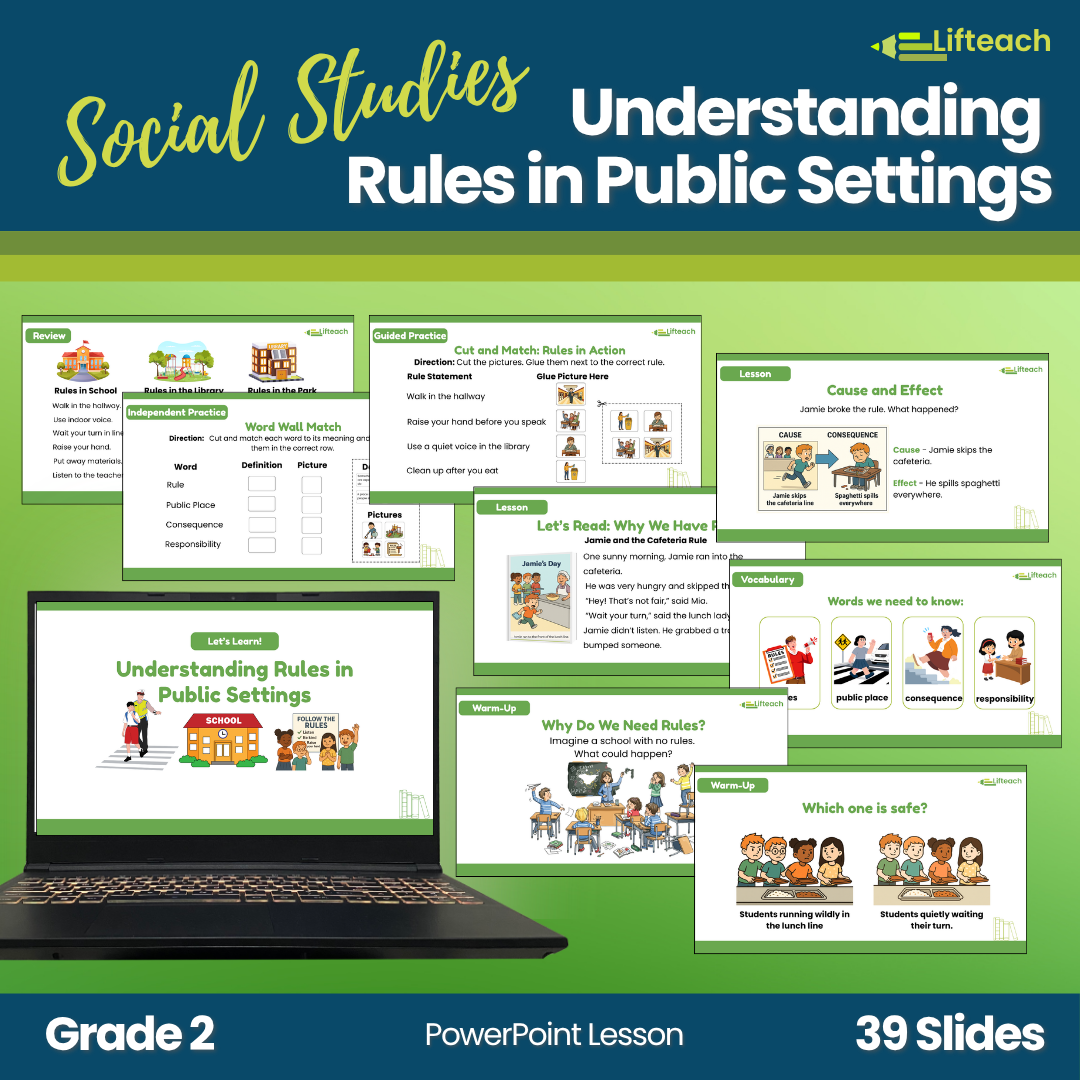
- Warm-Up / Hook: Display two simple cartoon panels:
– Panel A: Students running wildly in the lunch line.
– Panel B: Students quietly waiting their turn.
-
- Ask: “What’s happening in each picture? Which one looks safe or fair?”
- Briefly introduce: “Today, we’ll learn about rules that help everyone stay safe and happy in public places.
- Vocabulary Words
-
- RULE: A guideline that tells us how to behave.
- PUBLIC PLACE: Somewhere many people visit (school, library, park).
- CONSEQUENCE: What happens if you do—or don’t do—something.
- RESPONSIBILITY: Something you must take care of or follow.
b. Lesson Proper (15 minutes)
- Read-Aloud: “Why We Have Rules” story or scenario.
- Comprehension Check (SL.2.1, RI.2.1):
– “What rule did Jamie break?”
– “What happened because of it?”
- Record student responses on the board.
- Discuss about the rules in school, library, park and community.
c. Guided Practice (10 minutes)
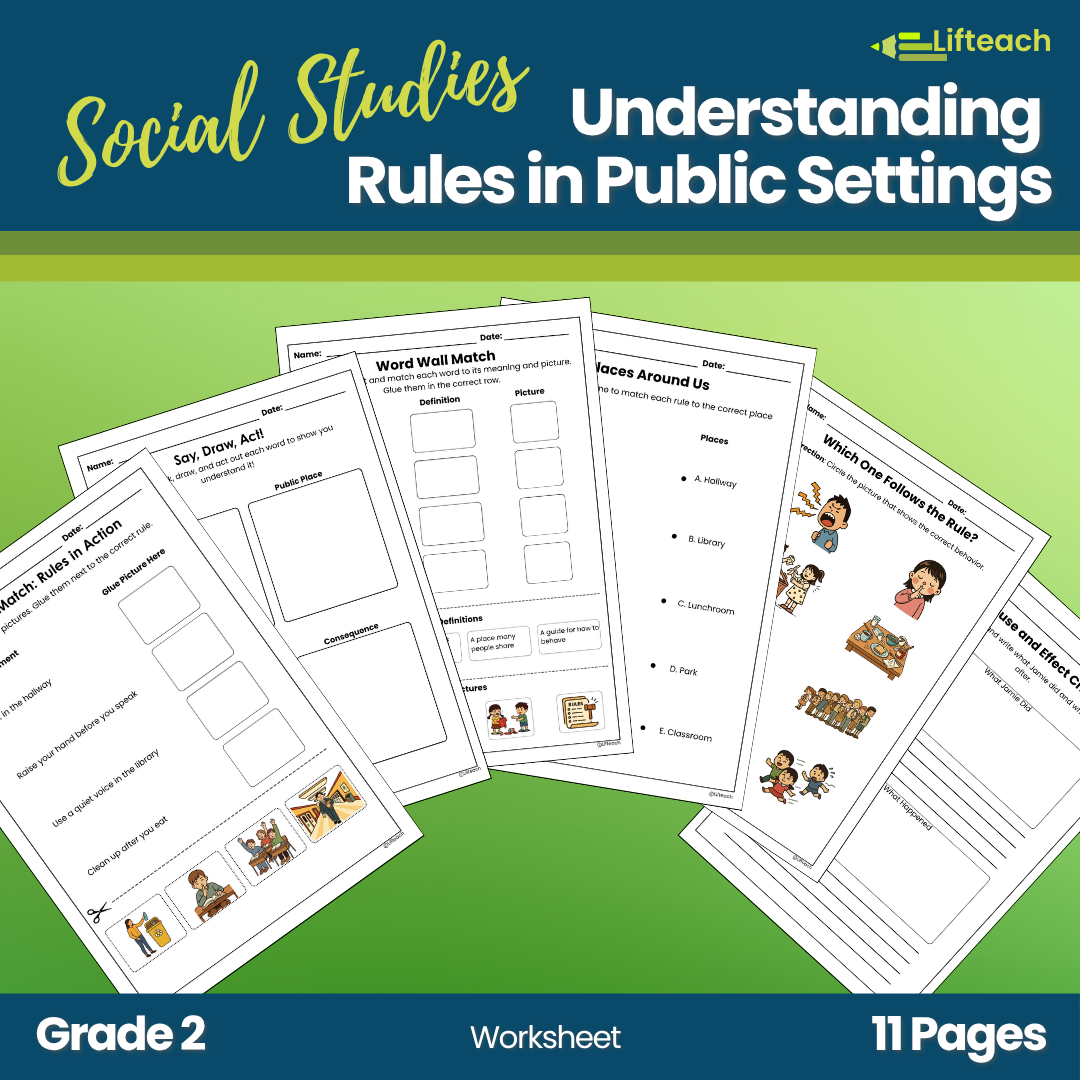
- Cut and Match: Rules in Action: Cut the pictures. Glue them next to the correct rule.
- Say, Draw, Act!: Look, draw, and act out each word to show you understand it!
d. Independent Practice (10 minutes)
- Cause and Effect Chart: Draw and write what Jamie did and what happened after.
- School Rules Chart: Fill in the chart. Write 3 rules and their benefits.
- Word Wall Match: Cut and match each word to its meaning and picture. Glue them in the correct row.
e. Closure & Review (5 minutes)
On a small slip, each student writes or draws:
- One public rule they follow in school.
- One reason it’s important (benefit or consequence).
f. Assessment Methods
- Places Around Us: Draw a line to match each rule to the correct place
- Which One Follows the Rule?: Circle the picture that shows the correct behavior.
6. Differentiation Strategies
- Struggling Learners / ELLs: • Provide sentence frames (“The rule is ____. It helps because ____.”) • Use bilingual vocabulary cards. • Pair with a buddy.
- Advanced Learners: • Challenge to draft a new rule for the playground, explain consequences. • Research a community rule (e.g., traffic lights) and present to class.
- Students with IEPs: • Offer graphic organizers pre-filled with prompts. • Provide extended time or one-on-one support during worksheet.
7. Lesson Timeline
| Time | Activity |
| 0–10 min | Introduction |
| 10–25min | Lesson Activity |
| 25–35 min | Guided Practice (Worksheet Packet |
| 35–45 min | Independent Practice (Worksheet Packet) |
| 45–50 min | Closure (Exit Ticket & Review) |
Introduction Video
PowerPoint Lesson