
Lesson Plan: Renewable vs. Nonrenewable Resources for Electricity Generation
Grade Level: Grade 4
Subject: Earth Science
Duration: 50 minutes
1. Learning Objectives
By the end of the lesson, students will be able to:
- Define and differentiate between renewable and nonrenewable energy resources.
- Identify examples of both types of resources used for electricity production.
- Gather, analyze, and use evidence to construct an argument about the benefits and drawbacks of renewable vs. nonrenewable energy.
- Communicate their arguments in both written and oral form, citing specific evidence.
2. Alignment to Standards
Next Generation Science Standards (NGSS):
– 4-ESS3-1: Obtain and combine information to describe that energy and fuels are derived from natural resources and impact the environment.
– 4-ESS3-2: Generate and compare multiple solutions to reduce the impacts of natural Earth processes on humans.
Common Core State Standards (CCSS) – English Language Arts:
– CCSS.ELA-LITERACY.W.4.1: Write opinion pieces that introduce a topic, state an opinion, supply reasons supported by facts and details, and provide a concluding statement.
– CCSS.ELA-LITERACY.SL.4.1: Engage effectively in a range of collaborative discussions; follow agreed-upon rules, and build on others’ talk to explore ideas.
3. Materials & Resources
- Projector or Smartboard
- Chart paper & markers
- Resource cards (pictures and facts about coal, oil, solar, wind, hydro, and biomass)
- Science journals or notebooks
- “Resource Sort” worksheet (Activity WS1)
- “Evidence Table” worksheet (Activity WS2)
- “Argument Outline” worksheet (Assessment WS1)
- “Energy Quiz” worksheet (Assessment WS2)
- Exit ticket slips
- Timer
- Colored pencils or crayons
4. Instructional Procedures
- Introduction (10 minutes)
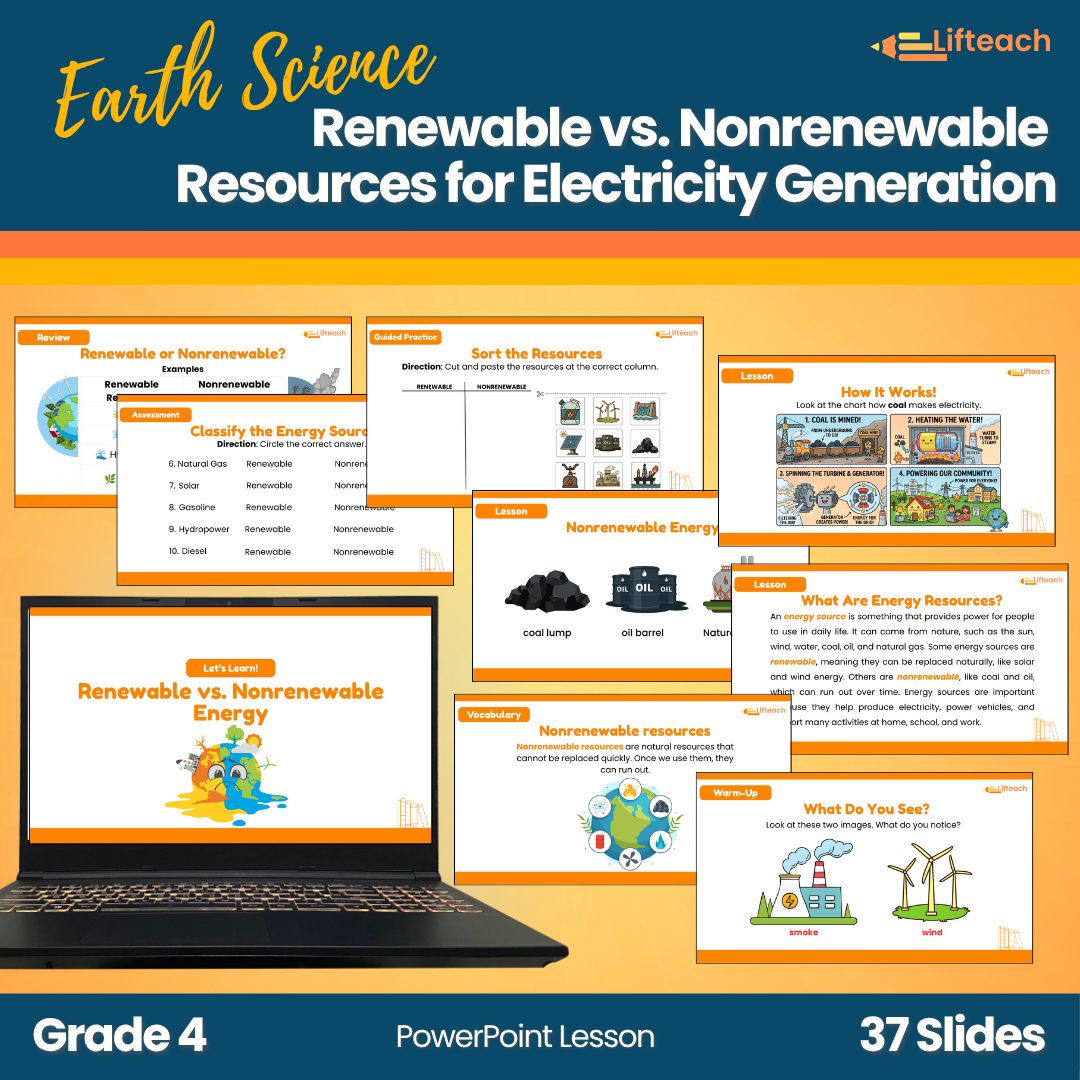
- Display two images: a coal plant chimney and a wind turbine.
- Prompt: “What do you notice? What questions do you have about these images?”
- Students discuss ideas with a partner (Think-Pair-Share).
- Solicit 2–3 quick responses; record key words (e.g., “smoke,” “clean,” “wind,” “pollution”).
5. Vocabulary Words
- Renewable resources – can be replaced quickly
- Nonrenewable resources—cannot be replaced quickly
- Electricity—energy used to power lights, machines, and devices
- Energy source—where energy comes from
6. Lesson Proper (15 minutes)
Direct Instruction:
- Define Renewable Energy Sources and Non Renewable energy sources and give examples.
- Show a brief video clip (2–3 minutes) on how wind turbines and coal power plants work.
- Show a comparison chart
7. Guided Practice (10 minutes)
- Sort the Resources: Cut and paste the resources at the correct column.
- Renewable vs. Nonrenewable Energy: Look at the list of energy resources. Write each one under the correct column: renewable or nonrenewable.
8. Independent Practice (10 minutes)
- Pros and Cons Table: Fill in at least 2 pros and 2 cons for each resource. Use facts from our activity, cards, or video
- Fill in the Blanks: Read each sentence and fill in the blanks with the correct word from the Word Bank.
9. Closure & Review (5 minutes)
- On a slip of paper, students answer: “Name one renewable and one nonrenewable resource and one reason we should use more renewable energy.”
10. Assessment Methods
- True or False: Write T if the statement is True and F if it is False in the blank.
- Classify the Energy Sources: Circle the correct answer.
11. Differentiation Strategies
Language Learners
- Provide sentence starters and bilingual vocabulary cards; pair with a fluent peer
Struggling Writers
- Graphic organizers; allow drawing diagrams; scribe support
Advanced Learners
- Offer extension: research a local renewable energy project and present findings
Kinesthetic Learners
- Use the resource-card relay race for the sorting activity
Visual Learners
- Color-code pros/cons on the evidence table; watch video
12. Lesson Timeline
| Time | Activity |
|---|---|
| 0–10 min | Introduction |
| 10–25 min | Lesson Activity |
| 25–35 min | Guided Practice (Worksheet Packet) |
| 35–45 min | Independent Practice (Worksheet Packet) |
| 45–50 min | Closure (Exit Ticket & Review) |
Introduction Video
PowerPoint Lesson