Lesson Plan: Changing the Movement of an Object Requires a Net Force
Grade Level: Grade 1
Subject: Science
Duration: 20, 30, or 45 minutes
At a Glance
- Grade: Grade 1
- Duration: 20, 30, or 45 minutes
- Standards: NGSS K-PS2-1 (pushes and pulls)
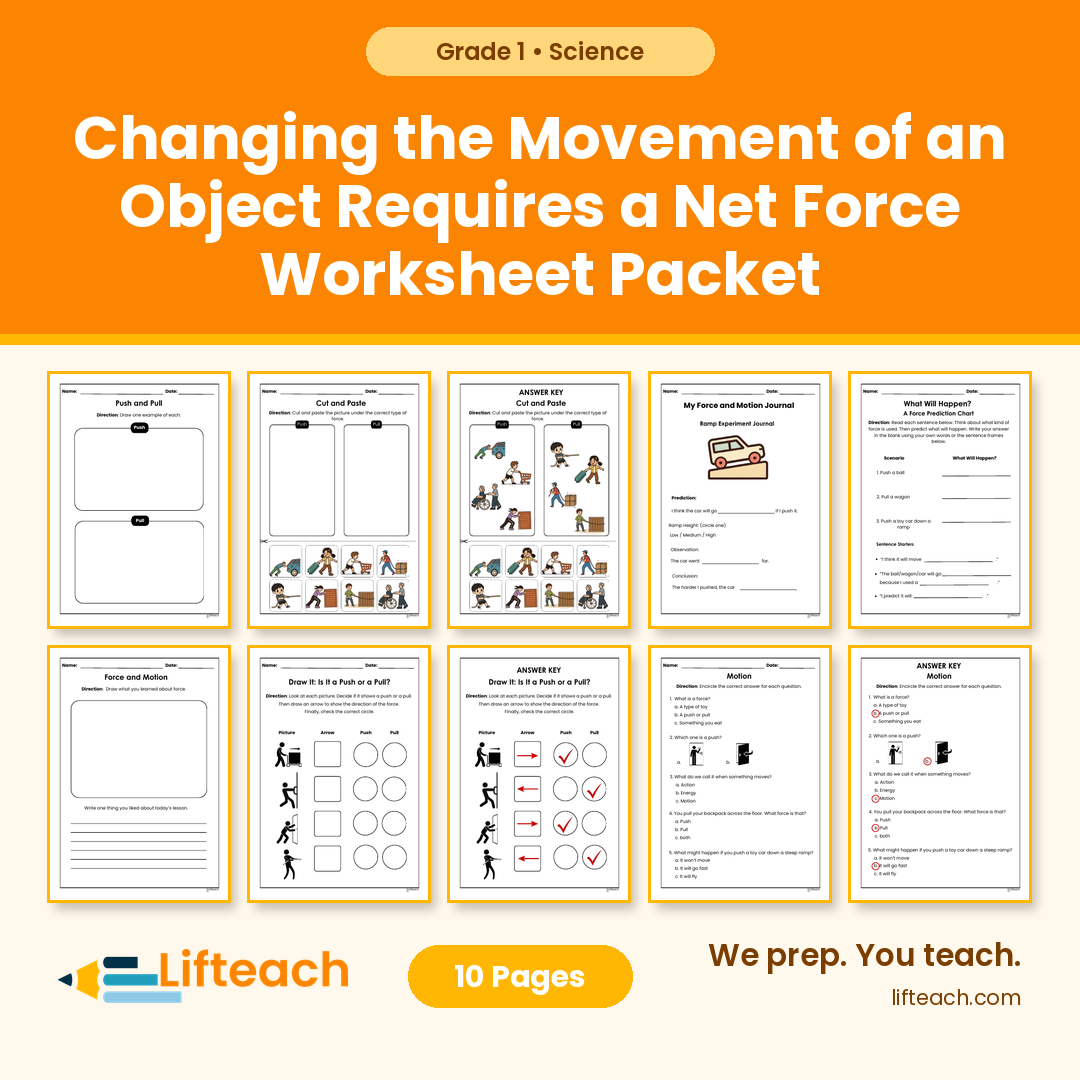
- Key materials: Changing the Movement of an Object Requires a Net Force PowerPoint (37 slides) + Worksheet packet (10 pages)
- Big idea: I can show how a push or a pull changes the way an object moves.
- Unit: Forces and Motion: Push and Pull
Lesson Materials
- Changing the Movement of an Object Requires a Net Force Worksheet
- Changing the Movement of an Object Requires a Net Force PowerPoint
1. Learning Objectives
By the end of this lesson, students will be able to:
- Tell that a force is a push or a pull, and that a force can make an object move (motion).
- Sort or draw examples of pushes and pulls, and show the direction of the force.
- Predict, test, and record how changing the strength of a push or the height of a ramp changes how far a car goes.
I can show how a push or a pull changes the way an object moves.
2. Standards Alignment
- NGSS K-PS2-1: Plan and conduct an investigation to compare the effects of different strengths or different directions of pushes and pulls on the motion of an object.
3. Required Materials & Resources
- Changing the Movement of an Object Requires a Net Force PowerPoint
- Changing the Movement of an Object Requires a Net Force Worksheet packet
- A book and a chair (or similar) for push and pull demos
- Toy car and a ramp you can set low, medium, and high
- Scissors, glue, and crayons
4. Vocabulary
| Word | Meaning | Picture cue |
|---|---|---|
| Force | A push or a pull acting on an object. | Hands pushing a box |
| Push / Pull | Push: move something away. Pull: bring something closer. | Push a book / pull a chair |
| Motion | When something moves. | Rolling car |
| Net force | The deck’s word for the push or pull that makes the object move. | One arrow on a car |
5. Timeline & Lesson Components
Choose the 45-, 30-, or 20-minute path. Times below are in minutes.
| Segment | Slides / pages | 45 min | 30 min | 20 min |
|---|---|---|---|---|
| 1. Hook | Slides 1–2 · What makes things move? | 6 · watch objects in motion; name push or pull | 5 · one demo, one label | 3 · “What makes this move?” |
| 2. Teach | Slides 3–13 · vocabulary (force, motion, net force, push, pull), ramps, book push, chair pull, motion | 12 · force = push or pull; motion = movement; a force causes motion | 8 · one push demo + one pull demo + words | 5 · push the book and name force + motion |
| 3. Guided | Slides 14–16 · Push and Pull draw · Cut and Paste | 8 · draw one of each; sort pictures under Push / Pull | 6 · draw page + two cut-and-paste items | 4 · draw one push and one pull |
| 4. Independent | Slides 17–20 · Ramp journal · Force Prediction Chart | 14 · predict, test low/medium/high, observe, conclude; then prediction chart or draw/write | 8 · one ramp height together + journal | 5 · teacher models one trial; students record |
| 5. Close | Slides 21–37 · review, Force and Motion draw, exit, Draw It: Push or Pull, circle questions | 5 · recap; exit: write or draw one learning; send assessment pages if time | 4 · exit + 2 Draw It items | 3 · exit |
Say: “A force is a push or a pull. When a force acts on an object, the motion can change. A harder push can make it go farther.”
Ask: “Is this a push or a pull? Which way is the force? What will happen if we push harder or raise the ramp?”
Watch for: Leave the car still. “Is there motion? What do we need to change its movement?” (A push or a pull.)
6. Instructional Activities & Strategies
Times in the headings follow the 45-minute path. See the table above for the 30- and 20-minute options.
Hook 6 min
- Slides 1–2: What makes things move?
- Watch objects in motion; name push or pull.
Teach 12 min
- Slides 3–13: vocabulary (force, motion, net force, push, pull), ramps, book push, chair pull, motion
- Force = push or pull; motion = movement; a force causes motion.
Guided 8 min
- Slides 14–16: Push and Pull draw · Cut and Paste
- Draw one of each; sort pictures under Push / Pull.
Independent 14 min
- Slides 17–20: Ramp journal · Force Prediction Chart
- Predict, test low/medium/high, observe, conclude; then prediction chart or draw/write.
Close 5 min
- Slides 21–37: review, Force and Motion draw, exit, Draw It: Push or Pull, circle questions
- Recap; exit: write or draw one learning; send assessment pages if time.
7. Starter Check
Use the warm-up as a quick starter check before teaching.
| # | Starter item | Answer |
|---|---|---|
| 1 | Draw one push | Object being moved away, e.g. pushing a swing or a book |
| 2 | Draw one pull | Object being brought closer, e.g. pulling a wagon or a chair |
| 3 | The book moved because I _____ it. That is a _____. | pushed (or pulled) · force |
If most students miss 2 or more: Do the book-push and chair-pull demos again. Students point “push” or “pull” before they draw.
8. Assessment
Exit ticket
| # | Question | Answer |
|---|---|---|
| 1 | Write or draw one thing you learned about forces and motion (or one thing you enjoyed) | On-topic: force = push or pull; a harder push or higher ramp changes motion; or a correct push/pull example. |
Score bands: Clear, accurate example or idea: secure · Partial (only “I pushed a car” with no motion idea): developing · Blank or “it moved by itself”: reteach
Reteach: Two trials with the car: gentle push vs. harder push. Student points to which went farther and finishes “A harder push makes the car ___.”
9. Worksheets
The Changing the Movement of an Object Requires a Net Force Worksheet packet is 10 pages (7 student pages + 3 answer-key pages).
| Page | Title | Type |
|---|---|---|
| 1 | Push and Pull (draw one of each) | Student page |
| 2 | Cut and Paste: Push or Pull | Student page |
| 3 | Cut and Paste | Answer key |
| 4 | My Force and Motion Journal (ramp experiment) | Student page |
| 5 | What Will Happen? A Force Prediction Chart | Student page |
| 6 | Force and Motion (draw and write) | Student page |
| 7 | Draw It: Is It a Push or a Pull? | Student page |
| 8 | Draw It: Is It a Push or a Pull? | Answer key |
| 9 | Motion (circle the answer) | Student page |
| 10 | Motion | Answer key |
| Level | Pages and task | Answer key |
|---|---|---|
| Guided | Push and Pull (draw one of each) · Cut and Paste (sort pictures) | One clear push and one clear pull. Cut-and-paste: see packet answer-key page (pictures under Push or Pull). |
| Independent | Ramp Experiment / Force and Motion Journal · What Will Happen? prediction chart | Journal: a prediction, a circled ramp height, an observation (how far), and a conclusion such as “The harder I pushed, the car went farther” (or the higher ramp, the farther the car). Predictions should name a likely change in motion. |
| Assessment | Draw It: Is It a Push or a Pull? (arrow + check) · encircle questions | Each picture labeled push or pull with an arrow in the direction of the force. Encircle items: see packet (answers follow push vs. pull and “a force changes motion”). |
10. Differentiation & Supports
Common misunderstandings
| If you hear or see | Say instead |
|---|---|
| “Things move by themselves, with no push or pull.” | Something starts or changes motion when a force acts on it. Show the book: it moves when we push. |
| “A harder push doesn’t change anything.” | A harder push or a higher ramp usually makes the car go farther. Test it. |
| “Push and pull are the same.” | Push moves an object away from you. Pull brings it toward you. |
Special education supports
- Sentence frames: “This is a push / pull.” · “The car will go ___ if I push harder.”
- Access: Real car and ramp · sentence starters on the prediction chart
- Respond: Point, say, draw, or write; circle or match instead of writing when needed
- Fine motor: Larger lines, glue sticks, or stamps instead of tiny writing
- Prompting: FP → PP → M → G → V → I · record highest
IEP Goal Bank connections
| Goal Bank ID | Practiced in |
|---|---|
| FA-ALL-SCIENC-02 · use senses to observe the environment | Demos · ramp journal |
| FA-ALL-PS-02 · similarities and differences using descriptors | Push vs. pull sort · far vs. near on the ramp |
UDL
| Principle | In this lesson |
|---|---|
| Engagement | Book and chair demos · toy-car ramp trials · draw a favorite push or pull |
| Representation | Live demos · arrows on pictures · sentence starters · journal table |
| Action & Expression | Draw, cut and paste, point, or write · oral conclusion accepted on the journal |
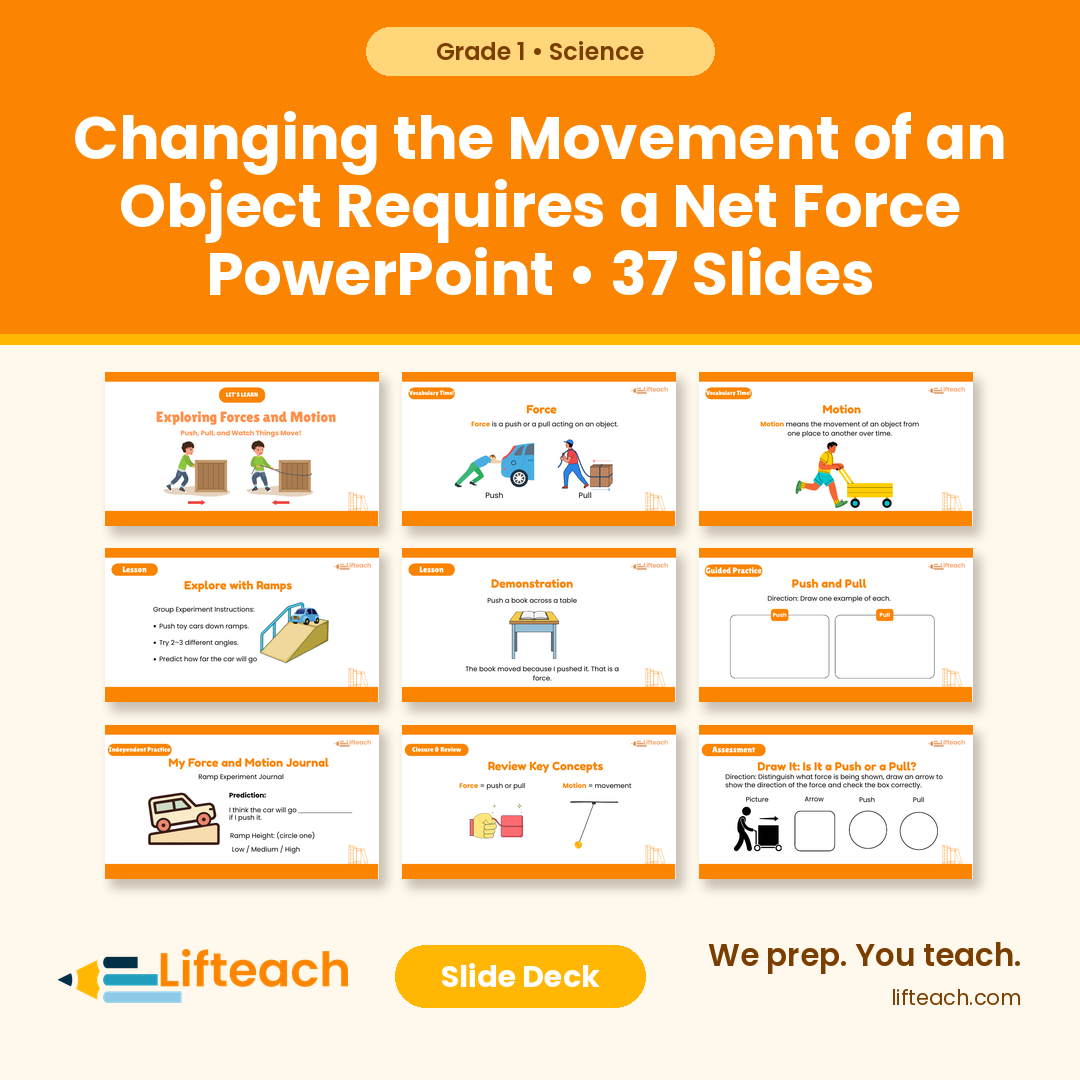
PowerPoint Lesson