Lesson Plan: Rivers, Lakes, and Oceans
Grade Level: Grade 2
Subject: Science
Duration: 20, 30, or 45 minutes
At a Glance
- Grade: Grade 2
- Duration: 20, 30, or 45 minutes
- Standards: NGSS 2-ESS2-3; related 2-ESS2-2 (map page)
- Key materials: Rivers, Lakes, and Oceans PowerPoint + Worksheet packet; 2 clear cups (tap water and salt water) for a look-and-touch test (no tasting)
- Big idea: I can compare different bodies of water.
- Unit: Unit 3 Earth’s Land and Water
Lesson Materials
1. Learning Objectives
By the end of this lesson, students will be able to:
- Name 3 bodies of water: river, lake, and ocean.
- Compare them: a river flows; a lake has land all around; an ocean is huge and salty.
- Tell that water on Earth can be liquid (rivers, lakes, oceans, rain) or solid (ice, snow, glaciers).
I can compare different bodies of water.
2. Standards Alignment
- NGSS 2-ESS2-3: Obtain information to identify where water is found on Earth and that it can be solid or liquid.
- Related: 2-ESS2-2: Model the land and bodies of water in an area (map page, packet p. 7).
3. Required Materials & Resources
- 2 clear cups (tap water and salt water) for a look-and-touch test (no tasting)
- Ice cubes
- Blue yarn for a river on the floor
- World map or globe
- Rivers, Lakes, and Oceans Worksheet packet
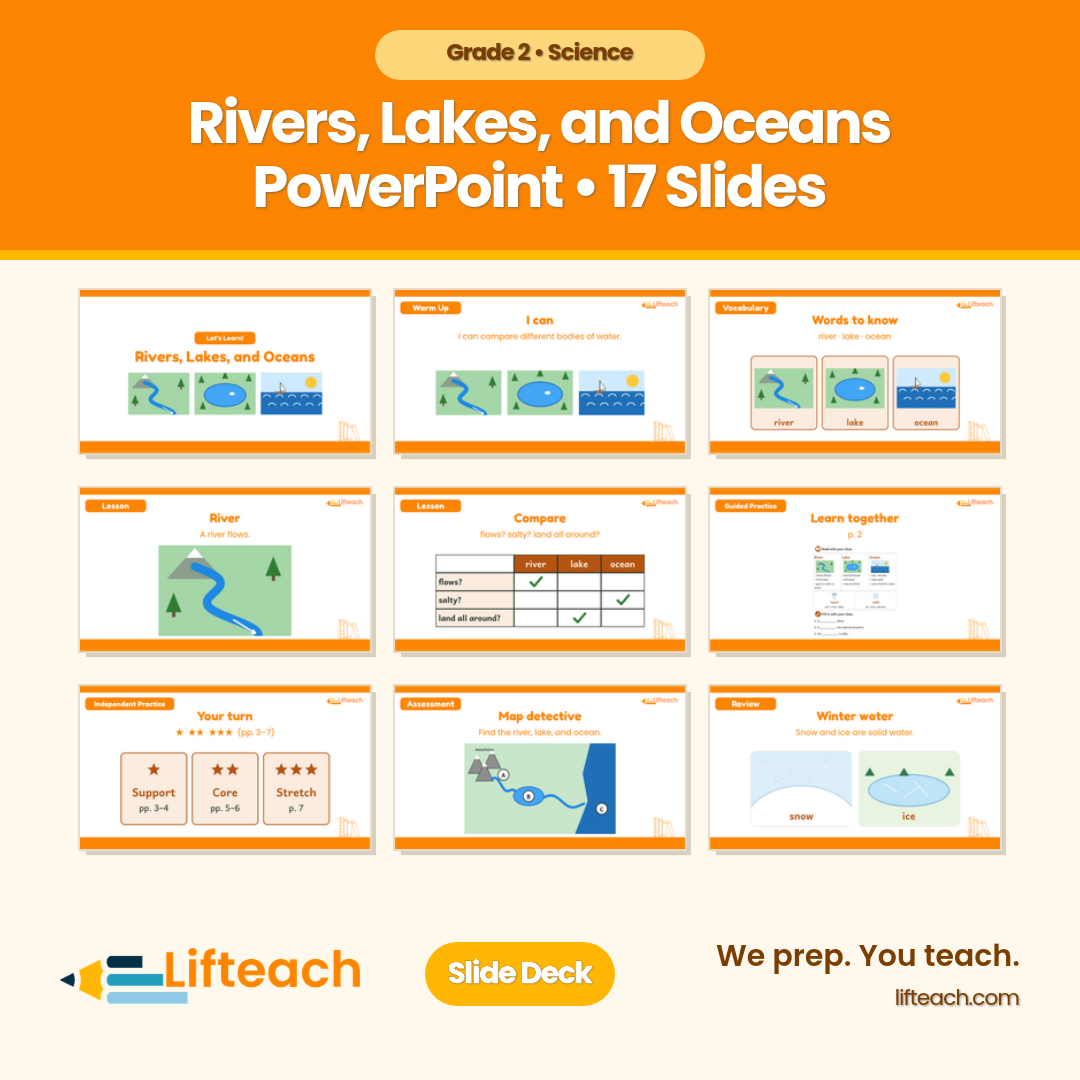
- Rivers, Lakes, and Oceans PowerPoint
- Lifteach CapCut video hook (play after the hook script on slide 5; pause three times). The YouTube link is not available yet because the video has not been uploaded.
4. Vocabulary
| Word | Meaning |
|---|---|
| River | Fresh water that flows downhill to a lake or the ocean. |
| Lake | Water with land all around it. Most lakes are fresh. |
| Ocean | A very big body of salty water. It holds most of Earth’s water. |
5. Timeline & Lesson Components
Choose the 45-, 30-, or 20-minute path. Times below are in minutes.
| Segment | Slides / pages | 45 min | 30 min | 20 min |
|---|---|---|---|---|
| 1. Hook | Packet p. 1 · slides 1–4 · video | 8 · warm-up p. 1, video with 3 pauses | 5 · warm-up, video to pause 2 | 3 · warm-up only |
| 2. Teach | Slides 5–10 · cups, ice, yarn river | 10 · river / lake / ocean + solid vs liquid demo | 7 · 3 bodies + ice cube | 5 · 3 bodies |
| 3. Guided | Packet p. 2 · slides 11–12 | 10 · p. 2 cards + fill-in | 6 · p. 2 | 4 · p. 2 fill-in |
| 4. Independent | Slide 13 · pp. 3–7 by level | 12 · ★ pp. 3–4 · ★★ pp. 5–6 · ★★★ p. 7 | 8 · one page per level | 5 · ★ p. 3 / ★★ p. 5 / ★★★ p. 7 |
| 5. Close | Slides 14–17 · p. 8 exit ticket | 5 · map on a globe, exit ticket | 4 · exit ticket | 3 · exit ticket Q1–3 |
Say: “Rivers flow. Lakes have land all around. Oceans are huge and salty.”
Ask: “Is it moving? Is it salty? Is there land all around?”
Safety: look at and touch the salt-water cup; no tasting.
6. Instructional Activities & Strategies
Times in the headings follow the 45-minute path. See the table above for the 30- and 20-minute options.
Warm-Up / Hook 8 min
- Teacher says/does: Students complete Warm-Up: Where Is Water? (page 1). Play the Lifteach CapCut video hook on slide 5, pausing at about 0:22, 0:32, and 0:50.
- Students do: Circle pictures that have water (including ice) and tell a partner where they have seen water.
Direct Instruction 10 min
- Teacher says/does: Teach river, lake, and ocean with the cups, ice, and a yarn river on the floor. Show that water can be liquid or solid. No tasting of the salt water.
- Students do: Compare moving vs. still water and fresh vs. salty water.
Guided Practice 10 min
- Teacher says/does: Read Let’s Learn: Bodies of Water (page 2) together and complete the fill-ins.
- Students do: Name which body of water flows, which has land all around, and which is salty.
Independent Practice 12 min
- Teacher says/does: Send students to a level: Support (pages 3–4), Core (pages 5–6), or Stretch (page 7 map detective).
- Students do: Match, circle, complete clue cards and a compare chart, or read a simple map.
Closure & Review 5 min
- Teacher says/does: Find a river, lake, and ocean on a globe, then students complete the exit ticket (page 8). On the 20-minute path, use questions 1–3 only.
- Students do: Show what they know about salty water, flowing water, and solid water.
7. Starter Check & Video Hook
Use packet page 1 as a starter check, then play the video hook with three pauses.
| # | Starter item (packet p. 1) | Answer |
|---|---|---|
| 1 | Ocean picture | Water |
| 2 | Desert picture | No water |
| 3 | Lake picture | Water |
| 4 | Rock picture | No water |
| 5 | River picture | Water |
| 6 | Iceberg picture | Water (solid) |
If most students miss 2 or more: spend 2 extra minutes showing an ice cube melting in a cup and saying, “Ice is water too.”
Before the video: “Look for water that moves and water that stays still.”
| Pause | Ask | Listen for |
|---|---|---|
| Pause 1 · ~0:22 | Where does a river start, and where does it go? | High land / mountains → lake or ocean. |
| Pause 2 · ~0:32 | What is all around a lake? | Land. |
| Pause 3 · ~0:50 | Why is ocean water different? | It is salty. |
These pause times match the Lifteach CapCut video plan. Adjust them if the final cut differs. The YouTube link is not available yet; the CapCut video has not been uploaded.
8. Assessment
Exit ticket
| # | Question | Answer |
|---|---|---|
| 1 | Which one is salty? river / lake / ocean | ocean |
| 2 | Water that flows downhill is a … | river |
| 3 | Ice is water that is … | solid |
| 4 | One way a lake is different from a river | A lake has land all around / still water; a river flows. |
Score bands: Out of 4: 4 secure · 3 developing · 0–2 reteach. On the 20-minute path (questions 1–3): 3 secure · 2 developing · 0–1 reteach.
Reteach: Q1 → salt-water cup. Q2 → walk the yarn river downhill. Q3 → ice-cube melt. Q4 → page 2 cards side by side.
9. Worksheets
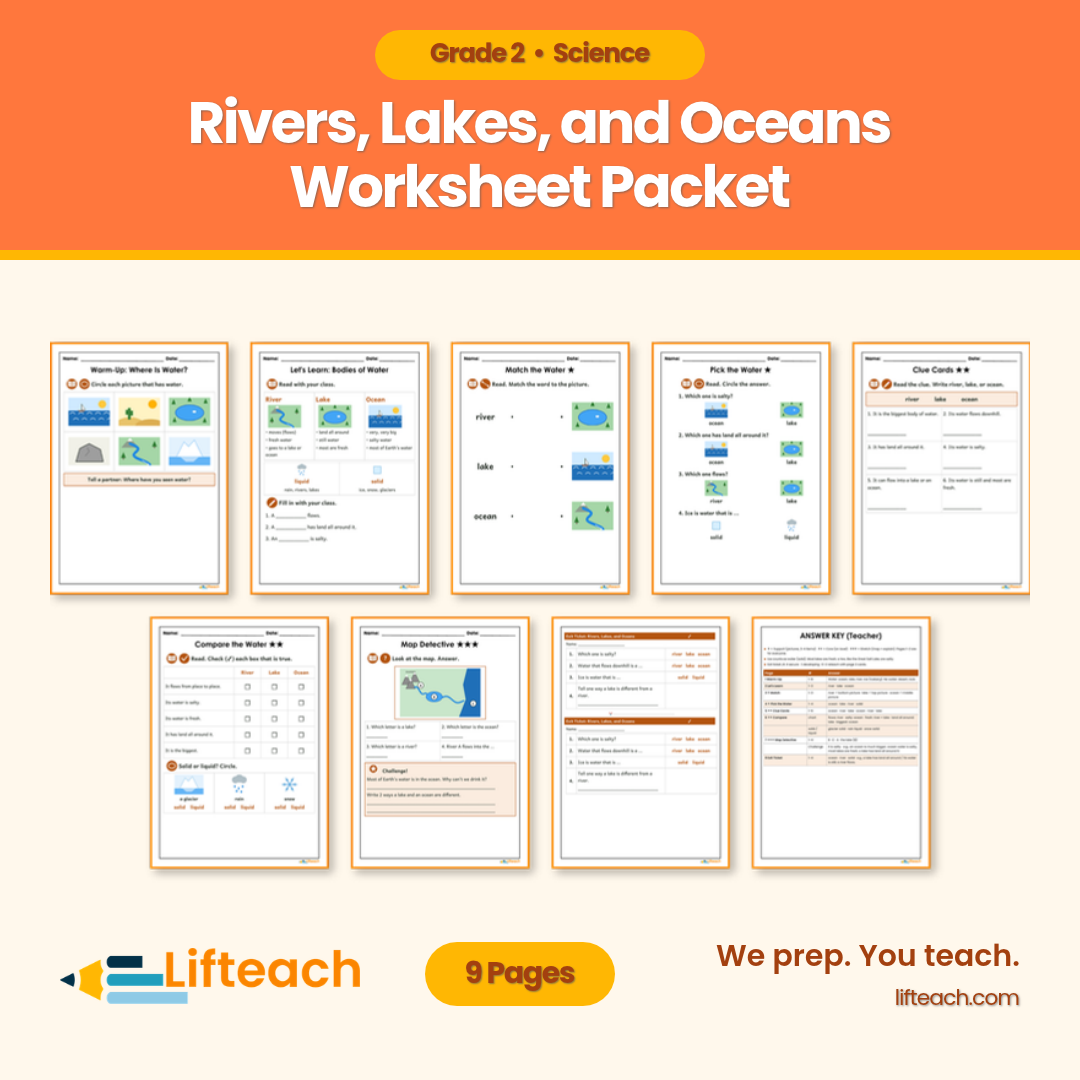
The source packet is 9 pages (8 student pages + a teacher answer key). Page numbers below are provisional until the final Canva PDF is ready. Rivers, Lakes, and Oceans Worksheet.
| Level | Pages and task | Answer key |
|---|---|---|
| Support (pages 3–4) | Match the word to the picture; circle the picture answer. | river–bottom, lake–top, ocean–middle / ocean, lake, river, solid |
| Core (pages 5–6) | Clue cards (6); compare chart plus solid or liquid. | ocean, river, lake, ocean, river, lake / see packet answer key |
| Stretch (page 7) | Map detective plus explain. | B, C, A, lake, salty, 2 differences |
Page 1 is the warm-up / starter. Page 2 is the guided “Let’s Learn” page. Page 8 is the exit ticket. Page 9 is the teacher answer key.
10. Differentiation & Supports
Common misunderstandings
| If you hear or see | Say instead |
|---|---|
| “All water is the same.” | Ocean water is salty. Most rivers and lakes are fresh. |
| “Ice and snow are not water.” | Ice and snow are water that is solid. |
| “A lake is a small ocean.” | A lake has land all around it and is usually fresh. An ocean is salty and much bigger. |
Special education supports
- Sentence frames: “A ___ has ___.” · “A lake is different from a river because ___.”
- Access and response: Picture-word cards; read clues aloud; real water, ice, and salt to look at and touch. Students may point, say, circle, or write; Support pages are picture choices. Gloves or a spoon may be used for the ice cube; skip the touch test if needed.
- Prompting: Prompting hierarchy: full physical → partial physical → model → gesture → verbal → independent. Record the highest independent level.
IEP Goal Bank connections
| Goal Bank ID | Practiced in |
|---|---|
| SL-ALL-CATEGO2-02 · sort pictures into 3 categories | p. 3 · p. 5 |
| MR-K3-PRF-09 · classify by attributes | p. 6 compare chart |
| FA-ALL-PS-02 · similarities and differences | p. 7 challenge · exit Q4 |
| ES-ALL-ER12-09 · read a simple map | p. 7 map |
| OE-K3-GEN-08 · speak in complete sentences | Frames · warm-up talk |
UDL
| Principle | In this lesson |
|---|---|
| Engagement | Real water, ice, and salt; act out a river with yarn; choose a level; winter tie-in: snow and ice are solid water. |
| Representation | Picture + word + 3 facts per body of water; map and globe; color: blue = water, green = land. |
| Action & Expression | Point, circle, check, write, or tell; partner talk prompts. |
PowerPoint Lesson