Lesson Plan: Positive and Negative Effects of Using Natural Resources
Grade Level: Grade 2
Subject: Social Studies
Duration: 50 minutes
At a Glance
- Grade: Grade 2
- Duration: 50 minutes
- Standards: Arizona 2.G2.3; CCSS RI.2.1, SL.2.1
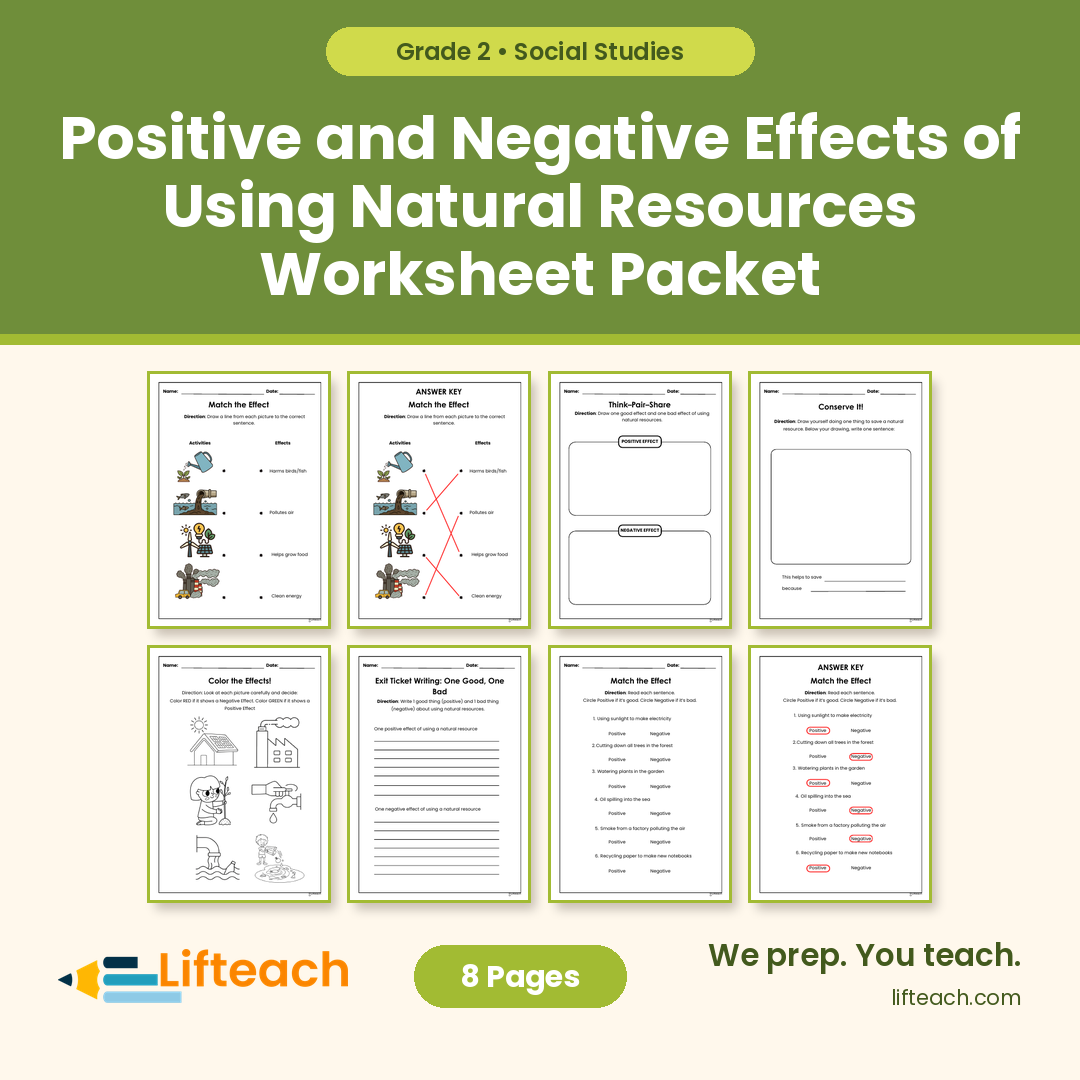
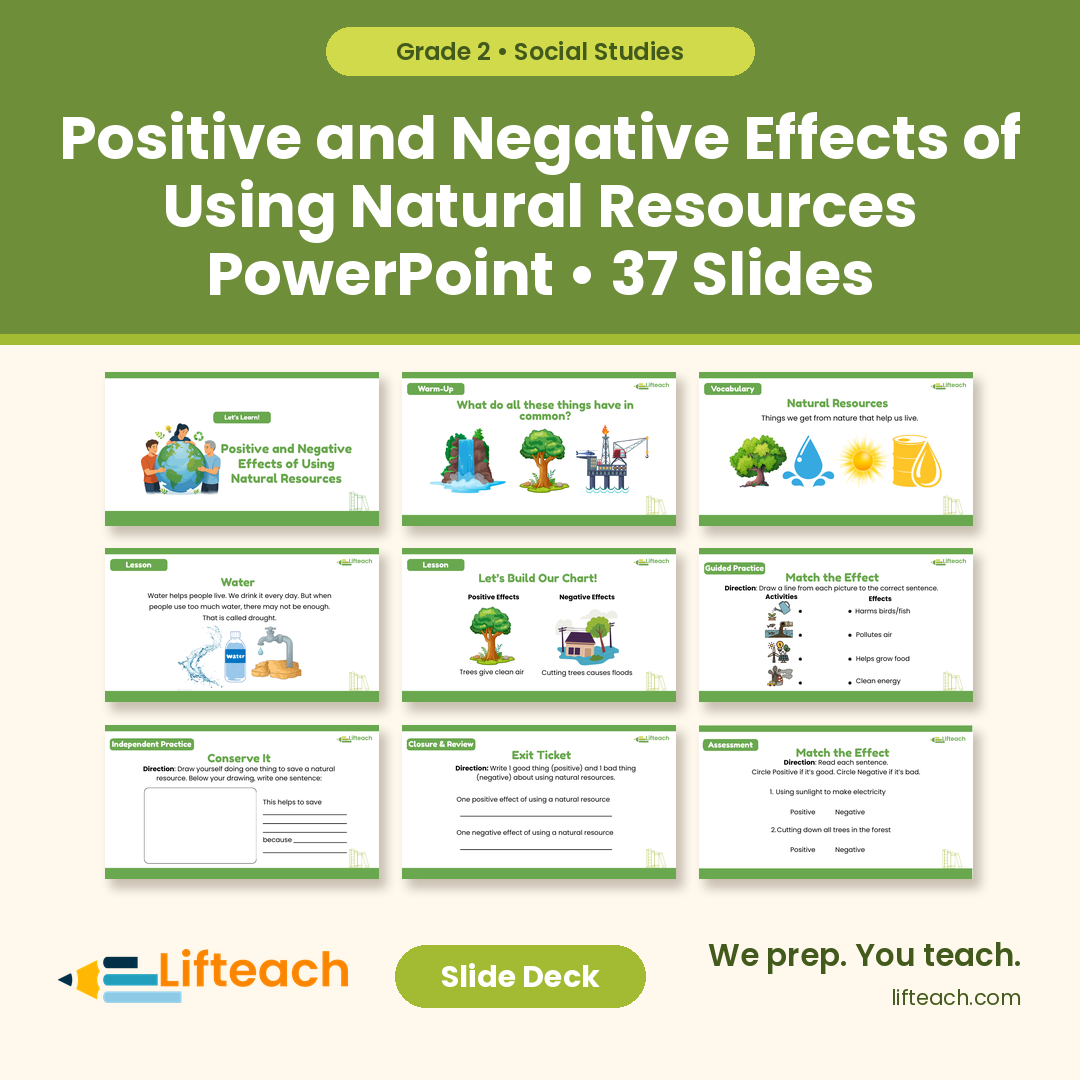
- Key materials: Positive and Negative Effects of Using Natural Resources PowerPoint (37 slides) + Worksheet packet (8 pages)
- Big idea: I can tell one good effect and one bad effect of using natural resources.
- Unit: Geography: People and the Environment
Lesson Materials
- Positive and Negative Effects of Using Natural Resources Worksheet
- Positive and Negative Effects of Using Natural Resources PowerPoint
1. Learning Objectives
By the end of this lesson, students will be able to:
- Define “natural resources.”
- Describe at least two positive effects and two negative effects of using natural resources.
- Illustrate one way to conserve a natural resource at home or at school.
I can tell one good effect and one bad effect of using natural resources.
2. Standards Alignment
- Arizona 2.G2.3: Describe the positive and negative effects of using natural resources.
- CCSS RI.2.1: Ask and answer such questions as who, what, where, when, why, and how to demonstrate understanding of key details in a text. (Students answer questions about positive and negative effects in a short read-aloud.)
- CCSS SL.2.1: Participate in collaborative conversations with diverse partners about grade 2 topics and texts with peers and adults in small and larger groups. (Think–Pair–Share.)
3. Required Materials & Resources
- Positive and Negative Effects of Using Natural Resources PowerPoint
- Positive and Negative Effects of Using Natural Resources Worksheet packet
- Chart paper and markers for a Positive vs. Negative Effects anchor chart
- Picture cards of natural resources (water, trees, coal, oil, sunlight)
- Student notebooks or drawing paper
- Colored pencils or crayons (including red and green)
- Exit ticket slips
- Timer or clock
4. Vocabulary
| Word | Meaning |
|---|---|
| Natural resources | Things we get from nature that people use. |
| Positive effect | A good result, or something helpful that happens. |
| Negative effect | A bad result, or something harmful that happens. |
5. Timeline & Lesson Components
This lesson runs 50 minutes. Times below are in minutes.
| Time | Component | Activity |
|---|---|---|
| 0–10 | Introduction | Warm-up (slides 2–12): picture of a waterfall, a tree, and an oil rig. “What do these have in common? Where do they come from?” Then sort natural vs. man-made pictures. Vocabulary (slides 13–15). |
| 10–25 | Lesson | Read-aloud on water (slides 16–20): drinking water (positive) and overuse causing drought (negative). Build the Positive / Negative Effects anchor chart for water, trees, and sunlight (slides 21–24). |
| 25–35 | Guided Practice | Match the Effect (page 1) and Think–Pair–Share: draw one good and one bad effect (page 3). |
| 35–45 | Independent Practice | Conserve It! (page 4) and Color the Effects! (page 5). |
| 45–50 | Closure | Exit ticket: one positive and one negative effect (page 6, slide 30). |
6. Instructional Activities & Strategies
Introduction: Warm-Up / Hook 10 min
- Show the waterfall, tree, and oil rig (slide 2). Ask: “What do all these things have in common? Where do they come from?”
- Record answers: water, wood, oil all come from nature, so they are natural resources.
- Play Natural or Man-made with the picture slides (slides 5–12).
- Teach natural resources, positive effect, and negative effect (slides 13–15).
Lesson 15 min
- Read aloud the short passage on water (slides 16–20): we drink it (positive); using too much can cause a drought (negative).
- Draw two columns, Positive Effects and Negative Effects. Volunteers name effects of using water, trees, and sunlight (slides 21–24).
- Model complete sentences: “A positive effect of using trees is ___.”
Guided Practice 10 min
- Match the Effect (page 1): draw a line from each picture to the right sentence.
- Think–Pair–Share (page 3): draw one good and one bad effect, then share with a partner.
Independent Practice 10 min
- Conserve It! (page 4): draw yourself saving a natural resource and finish the sentence.
- Color the Effects! (page 5): color green for a positive effect and red for a negative effect.
Closure & Review 5 min
- Exit ticket (page 6): write one positive and one negative effect of using natural resources.
7. Starter Check
Show the waterfall, tree, and oil rig on slide 2 and ask: “What do all these things have in common? Where do they come from?” Then run the Natural or Man-made picture sort (slides 5–12). Students who mix up natural and man-made items need the picture-word cards during the lesson.
8. Assessment
Exit ticket
| # | Question | Answer |
|---|---|---|
| 1 | One positive effect of using a natural resource | Any true helpful effect, e.g. water helps us drink and grow food; sunlight makes clean energy; trees give wood for homes. |
| 2 | One negative effect of using a natural resource | Any true harmful effect, e.g. cutting down too many trees harms animals; burning coal or oil pollutes the air; using too much water can cause a drought. |
Both effects correct and about natural resources: secure. One correct: developing. Neither, or positive and negative reversed: reteach with the anchor chart.
Assessment pages
- Match the Effect (page 7): Read each sentence. Circle Positive if it is good and Negative if it is bad. Key on page 8.
9. Worksheets
The Positive and Negative Effects of Using Natural Resources Worksheet packet is 8 pages (6 student pages + 2 answer-key pages).
| Page | Title | Type |
|---|---|---|
| 1 | Match the Effect (pictures) | Student page |
| 2 | Match the Effect | Answer key |
| 3 | Think–Pair–Share | Student page |
| 4 | Conserve It! | Student page |
| 5 | Color the Effects! | Student page |
| 6 | Exit Ticket Writing: One Good, One Bad | Student page |
| 7 | Match the Effect (Positive or Negative) | Student page |
| 8 | Match the Effect | Answer key |
10. Differentiation & Supports
- Struggling learners: Picture-word cards for the matching activity; sentence starters on the exit ticket (“A good thing is ___.”).
- English language learners: Pre-teach vocabulary with visuals; allow answers in their first language, then support translation.
- Advanced learners: List another effect not covered and explain why; help lead the anchor chart discussion.
PowerPoint Lesson