Lesson Plan: Exploring the Commutative and Associative Properties of Addition
Grade Level: Grade 2
Subject: Math
Duration: 50 minutes
1. Learning Objectives
By the end of the lesson, students will be able to:
- Use the commutative property of addition to reorder addends (e.g., 3 + 5 = 5 + 3) to add within 20.
- Use the associative property of addition to regroup addends (e.g., (2 + 3) + 4 = 2 + (3 + 4)) to add within 20.
- Explain in their own words how changing the order or grouping of addends can make addition easier.
2. Standards Alignment
Common Core State Standards – Mathematics
• CCSS.MATH.CONTENT.2.OA.B.2 Fluently add and subtract within 20 using mental strategies.
Note: “Students need not use formal terms” but will experience commutative and associative strategies.
3. Materials & Resources
- Individual whiteboards, dry?erase markers, erasers
- Counters (e.g., cubes or chips), 20 per student
- Number card sets (cards labeled 1–10)
- Chart paper & marker
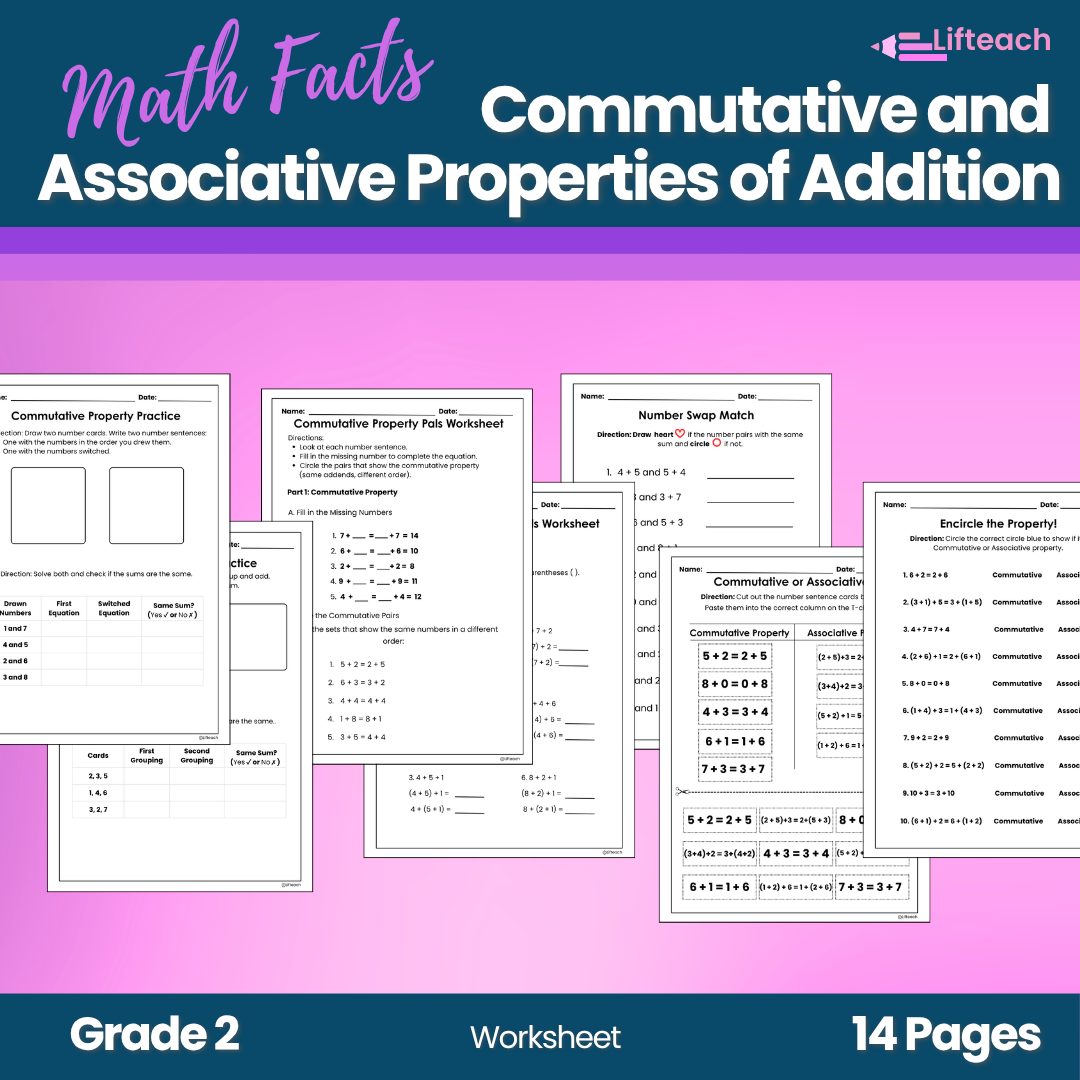
- “Property Pals” Worksheet (printable, 2 pages)
- Exit Ticket slips
- Timer or stopwatch
4. Lesson
a. Introduction(10 minutes)
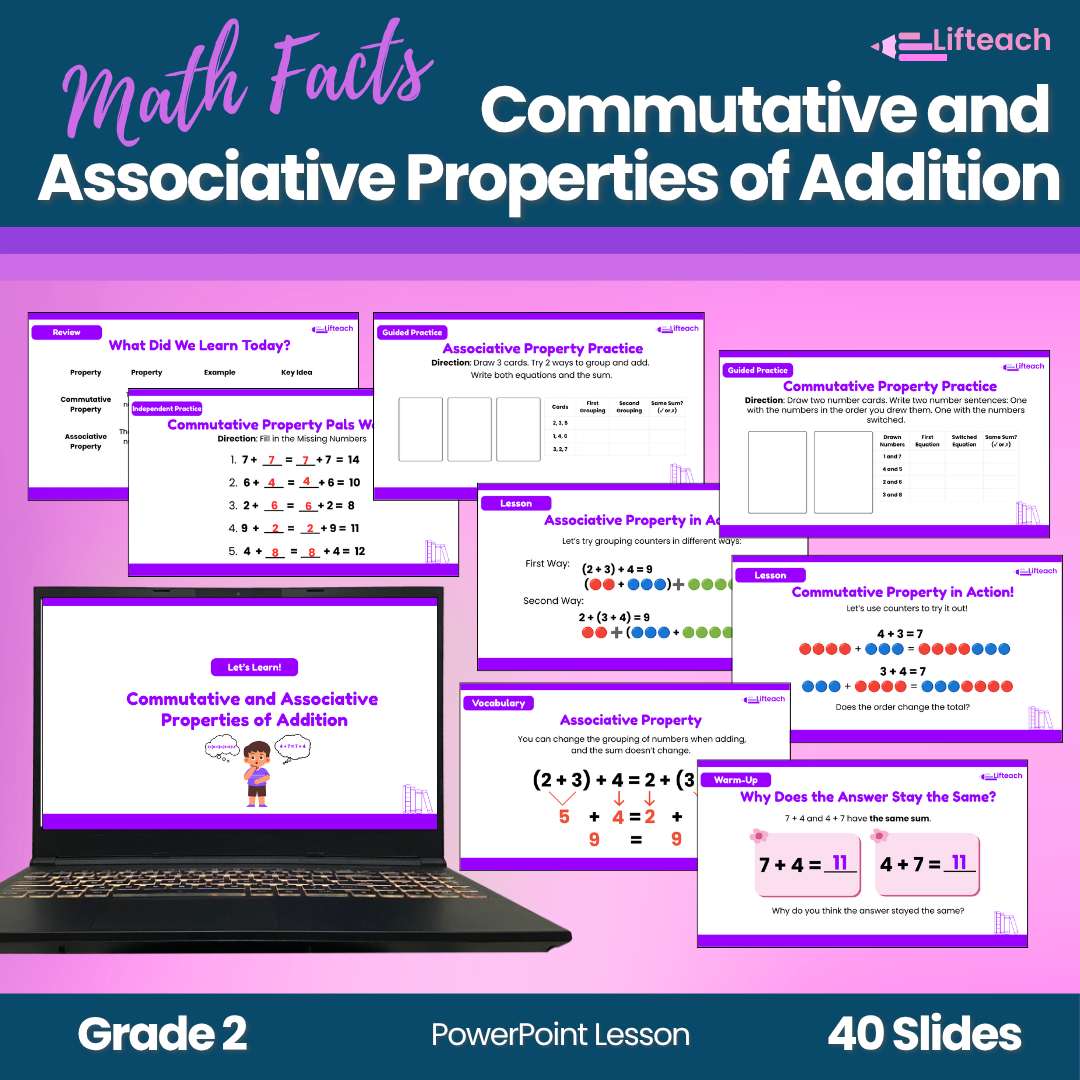
- Warm-Up / Hook: “Number Swap Race”. Flash two addends on board (e.g., 7+4). Students write answer and then swap the addends (4+7) and write again. Quick share: “Same sum? Why?”
b. Vocabulary Words:
-
- Addend: A number being added.
- Sum: The result of addition.
- Commutative Property: Changing the order of addends does not change the sum.
- Associative Property: Changing the grouping of addends does not change the sum.
c. Lesson Proper (15 minutes)
- Commutative Demo – Model 4+3 with counters, then 3+4. Emphasize “order doesn’t matter.”
- Associative Demo – Show (2+3)+4 vs. 2+(3+4). Use brackets, group counters.
d. Guided Practice (10 minutes)
Commutative Property Practice:
- Draw two number cards. Write two number sentences:
- One with the numbers in the order you drew them.
- One with the numbers switched.
Associative Property Practice:
- Draw 3 cards.
- Try 2 ways to group and add.
- Write both equations and the sum.
e. Independent Practice (10 minutes)
- Commutative Property Pals Worksheet: Fill in the Missing Numbers and Circle the sets that show the same numbers in a different order.
- Associative Property Pals Worksheet:
- Look at each set of three numbers.
- Group the numbers two ways using parentheses ( ).
- Solve both equations.
- Number Swap Match: Circle the number pairs with the same sum.
f. Closure & Review (5 minutes)
- On a slip, students write: “One way changing order/group helps me add faster is ___.” Collect before they leave.
5. Assessment
- Commutative or Associative: Cut out the number sentence cards below.Paste them into the correct column on the T-chart.
- Encircle the Property!: Circle the correct circle blue to show if it’s Commutative or Associative property.
6. Differentiation Strategies
a. Struggling Learners:
- Provide color? Coded counters & guided one? One practice.
- Offer simpler addend pairs (sums? 10).
b. On?Level Learners:
- Standard partner stations and worksheets.
c. Advanced Learners:
- Challenge: Create 4? Addend problems using both properties to find sums within 20.
- Explain why the properties hold using their own examples.
7. Lesson Timeline
| Phase | Duration | Core Activity / Focus | Primary Student Activity |
| 1. Introduction & Vocabulary | 10 min | Warm-Up (“Number Swap Race”) & Vocab | Practice mental addition, swap addends on whiteboards, and define key property terms |
| 2. Lesson Proper | 15 min | Concept Demonstration & Modeling | Observe counter demonstrations for commutative ($4+3 = 3+4$) and associative ($(2+3)+4 = 2+(3+4)$) grouping |
| 3. Guided Practice | 10 min | Interactive Card Drawing | Draw number cards in pairs to write commutative/associative equations in two different groupings |
| 4. Independent Practice | 10 min | Worksheet Completion | Complete “Property Pals” worksheets (filling in missing numbers, grouping with parentheses, matching equal sums) |
| 5. Closure & Review | 5 min | Synthesis & Exit Ticket | Reflect on how reordering or regrouping numbers makes addition faster and turn in exit ticket |
PowerPoint Lesson