Lesson Plan: Measuring Lenghts Using Inches, Feet, Centimeters, and Meters
Grade Level: Grade 2
Subject: Math
Duration: 60 minutes
1. Standards Alignment:
- CCSS.Math.Content.2.MD.A.1 – Measure the length of an object by selecting and using appropriate tools (e.g., rulers)
- CCSS.Math.Content.2.MD.A.3 – Estimate lengths using units of inches, feet, centimeters, and meters
2. Learning Objectives
By the end of this lesson, students will be able to:
- Select an appropriate unit (inches, feet, centimeters, meters) for estimating the length of common classroom objects.
- Make reasonable estimates of length in the four units.
- Use rulers and meter sticks correctly to measure lengths.
- Compare their estimates to actual measurements and compute differences.
3. Materials & Resources
- A variety of rulers (inches/cm)
- Meter sticks and measuring tapes (feet/meters)
- Classroom objects for measurement (books, desks, pencils, erasers, chairs)
- Sticky notes or index cards
- Chart paper & markers
- Individual whiteboards & dry?erase markers
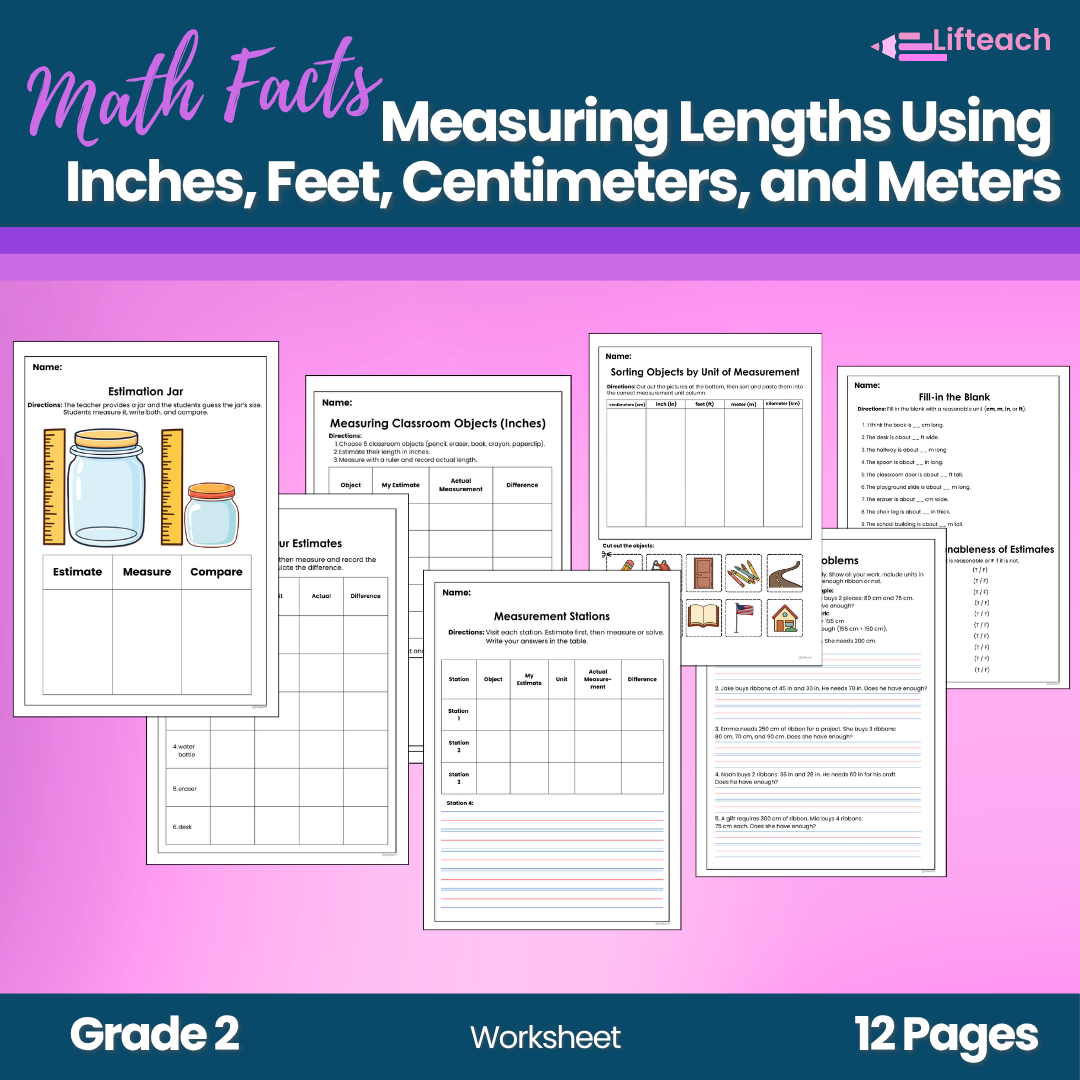
- Practice Worksheet #1 (Estimation Jar)
- Assessment Worksheet #2 (Measurement Stations)
- Exit Ticket slips
- 15 Additional Worksheets (listed at end)
4. Lesson Timeline
| Phase | Duration | Core Activity / Focus | Primary Student Activity |
| 1. Warm-Up & Introduction | 5 min | Hook, Turn & Talk, Unit Discussion | Compare object lengths, establish benchmark units |
| 2. Lesson Proper | 20 min | Direct Instruction & Teacher Modeling | Guided estimation, zero-point ruler alignment demonstration |
| 3. Independent Practice | 20 min | Worksheet #1: Estimation Jar | Individual estimation and actual measurement recording |
| 4. Assessment Stations | 10 min | Worksheet #2: Station Rotations | Small group rotations measuring small, medium, and large items |
| 5. Review & Exit Ticket | 5 min | Debrief & Individual Check | Whole-class reflection and quick exit ticket check |
A. Warm-Up / Introduction (5 min)
Hook: Show two pencils of different lengths and ask, “Which one do you think is longer?”
Turn & Talk: Students compare the pencils and estimate “about how many inches” each pencil is.
Share Out: Collect 3–4 estimates and record on chart paper under headings: Inches, Feet, Centimeters, Meters.
Connect to Objective: Explain that today we will learn how to pick the right unit and estimate lengths better.
B. Lesson Proper / Guided Instruction (20 min)
Unit Discussion (5 min):
- Show each measuring tool: inch/cm ruler vs. meter stick.
- Discuss when you’d use each tool (e.g., small objects = inches/centimeters; large = feet/meters).
Modeling (5 min):
- Teacher models how to estimate length of a textbook in centimeters, then measures and shows difference between estimate and actual.
- Repeat for a chair in feet or a table in meters.
Think-Aloud & Guided Practice (10 min):
- Project an image of a playground slide and ask students to estimate its height in feet.
- Guide them through reasoning: “A meter stick is about as tall as our teacher. The slide is a bit taller—maybe 2 meters?”
- Convert 2 m to feet (~6 ft) together.
C. Independent Practice / Activity (20 min)
Students receive Worksheet #1: Estimation Jar
Task: Estimate the lengths of pictured objects in inches, cm, feet, or meters, then measure and record the actual length.
Circulate, prompt with questions: “Why did you choose inches?” “How close was your estimate?”
D. Assessment (10 min)
Students receive Worksheet #2: Measurement Stations
Set up 4 stations:
- Station A: Small objects + inch/cm rulers
- Station B: Medium objects + foot measuring tapes
- Station C: Large objects + meter sticks 4
- Station D: Word problems estimating vs. actual
In pairs, students rotate every 3–4 min, complete the station sheet, and swap.
E. Review & Exit Ticket (5 min)
- Class Discussion: Which unit was easiest? Hardest? Why?
- Exit Ticket: On a slip, students write one object in the room and estimate its length in the most appropriate unit.
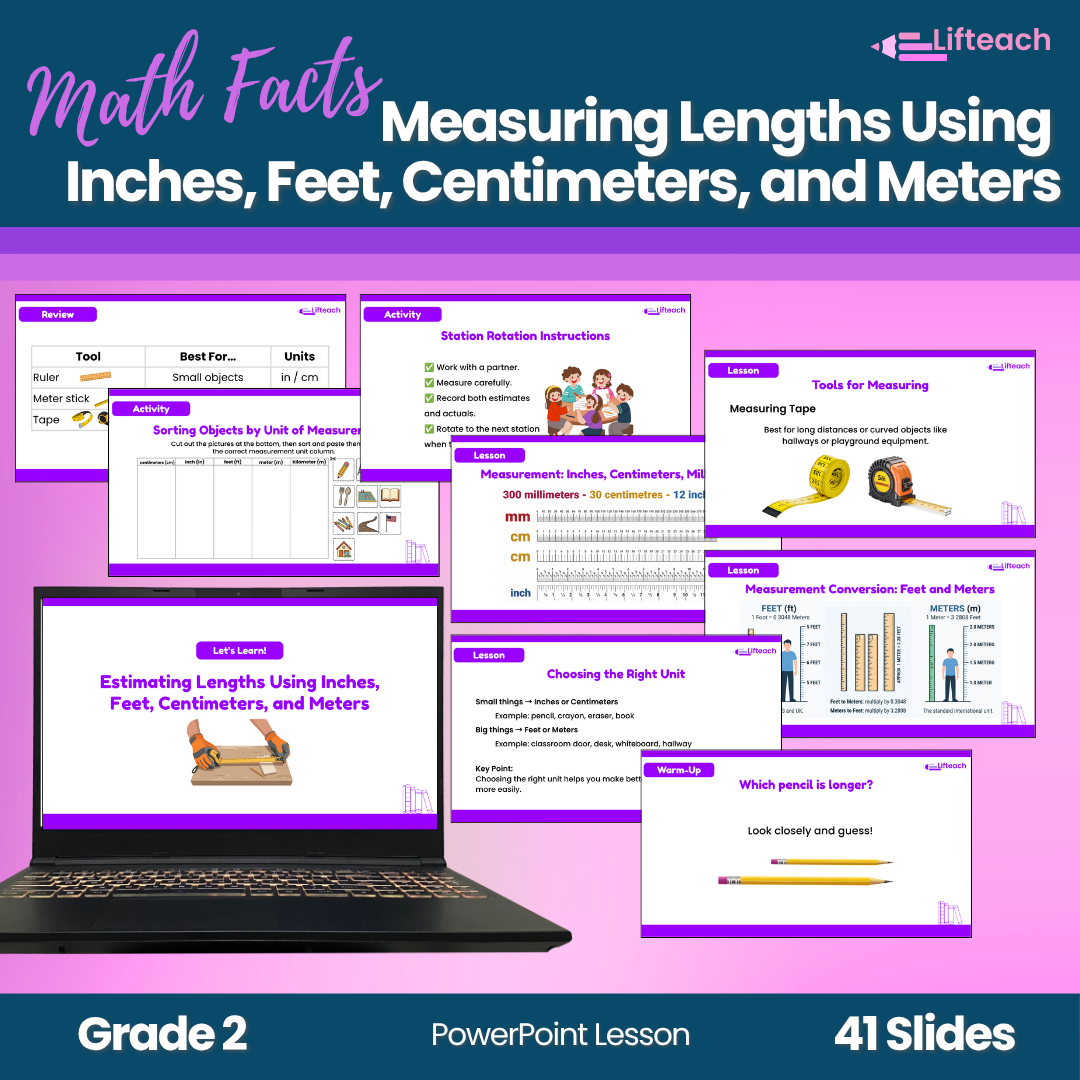
PowerPoint Lesson