Lesson Plan: How Human Activities Affect Communities & the Environment
Grade Level: Grade 2
Subject: Social Studies
Duration: 50 minutes
1. Learning Objectives
By the end of this lesson, students will be able to:
-
Define key terms: community, environment, pollution, recycle, and resource.
-
Describe two ways human activities (e.g., farming, building roads, recycling) affect a local community and its environment.
-
Give examples of positive and negative effects of those activities.
2. Standards Alignment
Common Core State Standards (CCSS), ELA – Literacy in History/Social Studies
-
CCSS.ELA-LITERACY.RI.2.3 Describe the connection between a series of historical events, scientific ideas, or steps in technical procedures in a text.
-
CCSS.ELA-LITERACY.W.2.2 Write informative/explanatory texts in which they introduce a topic and use facts and definitions to develop points.
3. Materials & Resources
-
Picture cards of human activities (farming, construction, recycling)
-
Short illustrated text or printed story about a town’s activities
-
5 index cards with vocabulary words and simple definitions
-
Chart paper & markers
-
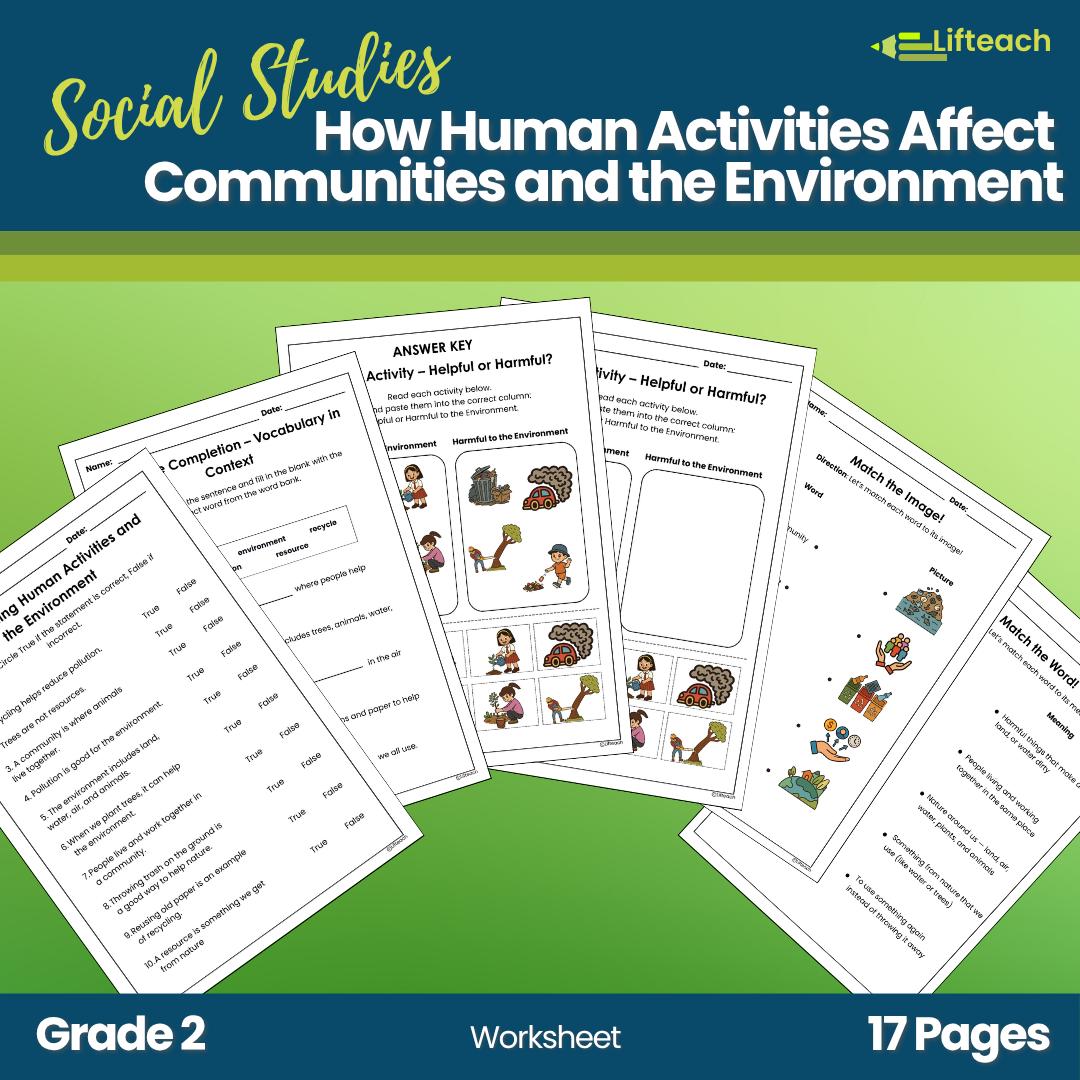
Positive/Negative Effects T-Chart handout (Worksheet 1)
-
Vocabulary matching worksheet (Worksheet 2)
-
Exit ticket slips (½ sheet)
-
Video clip (2-3 minutes) on community gardening (optional)
-
Pencils, crayons
4. Timeline & Lesson Components
| Time | Component | Activities & Strategies |
|---|---|---|
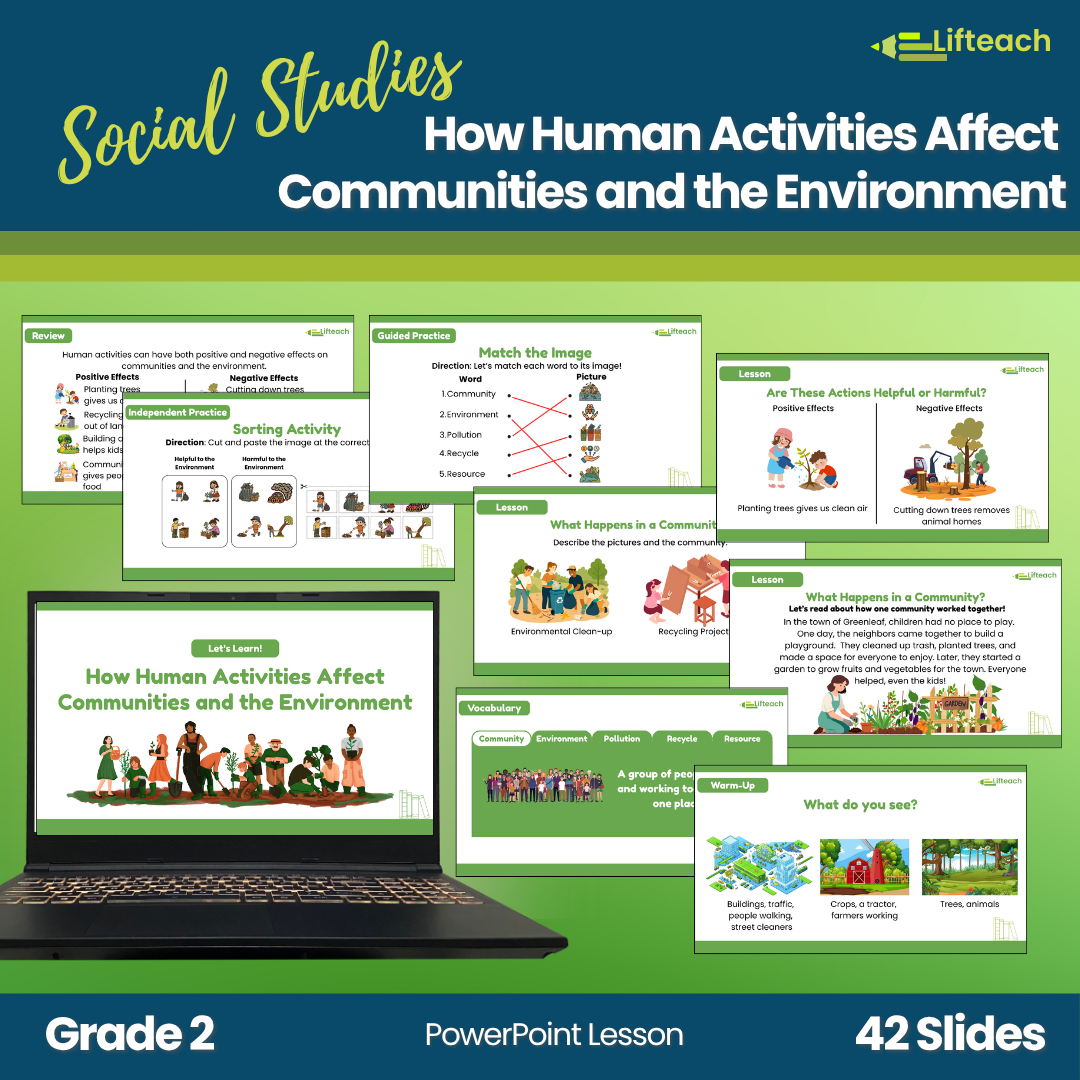
| 0-5 | Warm-up / Hook | Show 3 picture cards (city, farm, forest).
Ask: What do you see? Who works here? What do they do? |
| 5-10 | Vocabulary | Reveal 5 vocab cards: community, environment, pollution, recycle, and resource.
Students repeat & draw quick sketches. |
| 10-20 | Lesson Proper | Read a short story about building a playground and planting trees.
Aks students to talk about the two pictures. Create a class T-chart: Positive & Negative Effects. |
| 20-30 | Guided Practice | In pairs, distribute Worksheet 1 (T-Chart).
Each pair picks one activity card and fills out a chart: effects on people/community vs. environment. |
| 30-35 | Formative Test | Exit ticket: Name an activity and tell one way it helps OR hurts our environment. |
| 35-40 | Review | Volunteers share exit tickets.
The teacher highlights correct answers & addresses misconceptions. |
| 40-45 | Reflection | Students draw one activity they can do at home (e.g., planting, recycling) and write one sentence explaining its effect. |
| 45-50 | Worksheets / Closure | Distribute Worksheet 2 (vocab matching) for independent or homework.
Brief recap & preview of the next lesson. |
5. Instructional Activities & Strategies
-
Hook (Visual Inquiry): Stimulate curiosity by showing real photos of different regions.
-
Direct Instruction: Introduce and define vocabulary with visuals and student sketches.
-
Interactive Read-Aloud / Video: Model note-taking on chart paper; think-aloud about effects.
-
Collaborative Learning: Pair work on T-Chart to support communication & social skills.
-
Formative Assessment: Exit tickets quickly gauge individual understanding.
-
Reflection & Art Integration: Drawing + sentence writing addresses multiple intelligences.
6. Assessment Methods
-
Observation during partner work and class discussion
-
T-Chart worksheet (1)
-
Exit ticket responses
-
Vocabulary matching worksheet (2)
-
Reflection drawing & sentence
7. Differentiation Strategies
-
Struggling Learners / ELLs: Provide sentence frames (When people ____, the environment __.) Pair with a peer mentor. Offer a bilingual glossary or picture dictionary
-
Advanced Learners: Challenge to research one local human activity and present 2-3 effects Write a short paragraph explaining how a community project improved a region
-
Special Needs: Use larger visuals and manipulatives Allow extra time or shortened tasks Provide one-on-one support during activities
8. Worksheets
Worksheet 1: Positive / Negative Effects T-Chart
-
Left column: List human activity (e.g., building roads)
-
Two columns: Positive Effects on Community & Environment and Negative Effects on Community & Environment
Worksheet 2: Vocabulary Matching
-
Column A: Words (community, environment, pollution, recycle, resource)
-
Column B: Definitions and pictures
-
Task: Draw a line matching each word to its definition
9. Reflection & Next Steps
-
Students share their reflection drawings and sentences aloud or in small groups.
-
The teacher collects exit tickets and worksheets to inform the next lesson (e.g., solutions for reducing negative impacts).
-
Extension homework: Interview family about one activity they do to help the environment at home.
Introduction Video
PowerPoint Lesson