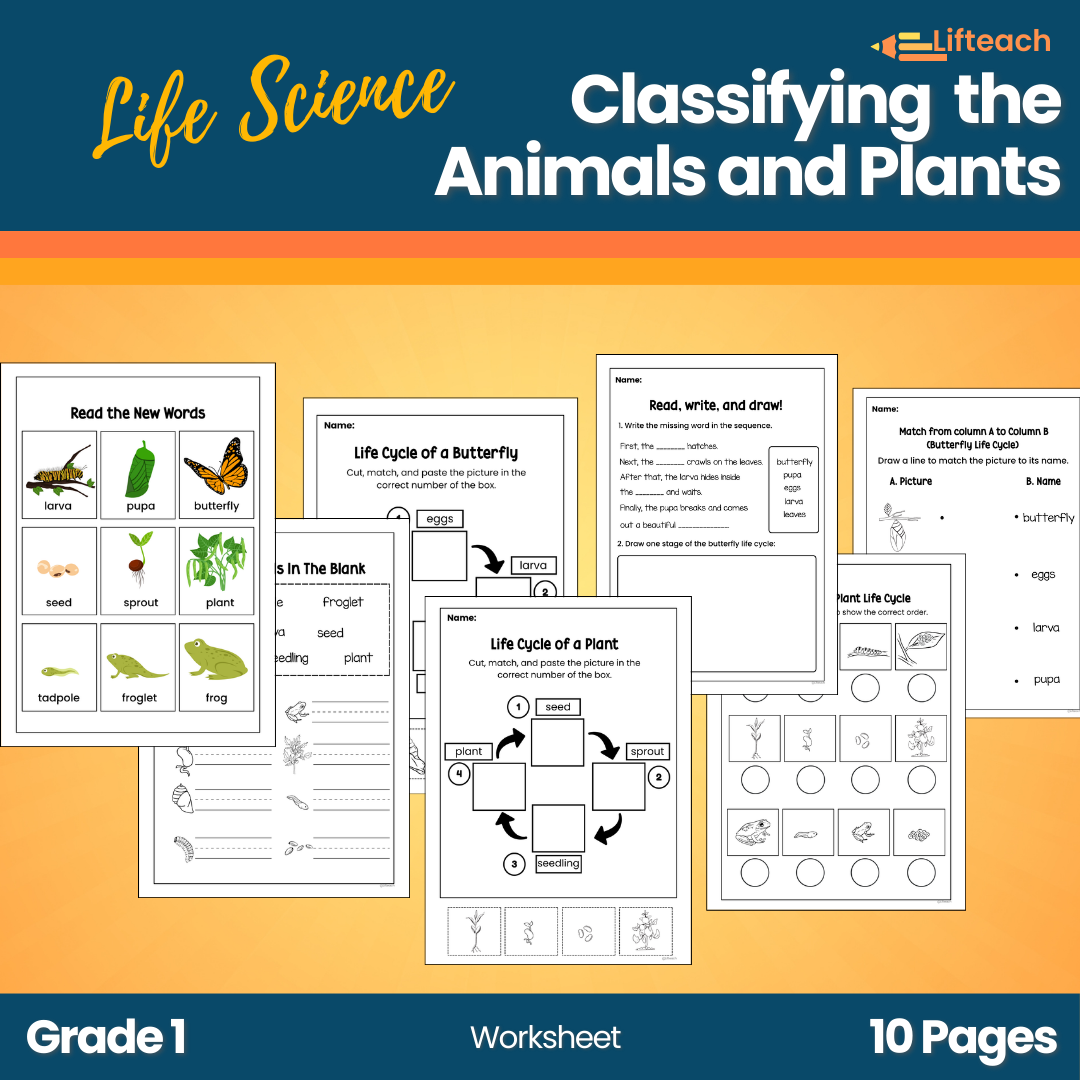
Lesson Plan: Classifying Animals and Plants
Grade Level: Grade 1
Subject: Life Science
Duration: 50 minutes
1. Learning Objectives
By the end of this lesson, students will be able to
- Define and use key vocabulary related to classification (group, subgroup, species).
- Sort pictures of animals and plants into appropriate groups based on shared characteristics.
- Explain why organisms are grouped together (e.g., all mammals have hair).
- Complete a simple worksheet to demonstrate understanding of groups and subgroups.
2. Standards Alignment
Common Core State Standards (CCSS) – ELA Integration
- CCSS.ELA-LITERACY. RI.1.1: Ask and answer questions about key details in a text.
- CCSS.ELA-LITERACY.RI.1.2: Identify the main topic and retell key details of a text.
- CCSS.ELA-LITERACY.SL.1.1: Participate in collaborative conversations about grade-level topics and texts.
- CCSS.ELA-LITERACY.L.1.4: Determine or clarify the meaning of unknown and multiple-meaning words and phrases.
3. Required Materials & Resources
- Picture cards of 12 animals (e.g., dog, cat, fish, bird, frog, snake, etc.)
- Picture cards of 12 plants (e.g., sunflower, pine tree, moss, fern, rose, cactus, etc.)
- Large Venn diagram chart on chart paper or whiteboard
- Pocket charts or sorting mats labeled “Animals,” “Plants,” or “Subgroups”
- Student worksheets (see the “Worksheets” section)
- Glue sticks, crayons, pencils
- Interactive read-aloud book or poster about animal and plant groups (optional)
4. Vocabulary
- Group: A set of organisms that share common traits.
- Subgroup: A smaller set within a group, sharing more specific traits.
- Species: A type of organism that can live and reproduce together.
- Mammal/Reptile/Bird: Examples of animal subgroups.
- Flowering Plant/Non-flowering Plant: Examples of plant subgroups.
5. Lesson Timeline & Activities
| Time | Component | Teacher Actions | Student Actions |
| 0-5 min | Warm-Up/Hook | Show mystery bag with 2-3 animal/plant pictures.
Ask: “Is this an animal or plant? Why?” |
Observe pictures
Respond with thumbs-up/down & share ideas. |
| 5-15 min | Vocabulary Introduction | Introduce key terms with visuals.
Use each in a sentence. |
Listen & repeat.
Point to pictures when terms are used. |
| 15-25 min | Lesson Proper | Read a short informational poster or book excerpt.
Model sorting cards into “Animals” vs. “Plants” and then into subgroups using a Venn diagram. |
Help place cards in the correct sections.
Answer guiding questions. |
| 25-35 min | Guided Practice | Distribute mixed picture cards & sorting mats.
Circulate to prompt thinking: “Why does a frog go here?” |
In pairs, sort cards into a group/subgroup.
Explain choices to partner |
| 35-45 min | Assessment | Hand out worksheet (cut-and-paste activity).
Explain directions: glue pictures under correct headings. |
Complete the worksheet individually.
Color pictures and labels. |
| 45-48 min | Review | Project completed worksheet example
Call on volunteers to share one classification fact. |
Listen and share one thing learned. |
| 48-50 min | Reflection/Exit Ticket | Ask, Why do we group organisms? â€
Students draw their favorite subgroup and write one sentence. |
Draw & write a sentence.
Turn in the exit ticket. |
6. Practice & Assessment Methods
- Formative:
– Observation during sorting activity
– Partner discussions use of vocabulary
– Q&A during lesson proper
- Summative:
– Completed worksheet (cut-and-paste with labels)
– Exit ticket drawing + sentence
7. Differentiation Strategies
- For ELL/Struggling Learners:
– Provide picture-only cards with color-coded borders matching mats
– Pair with a peer buddy for sorting tasks
– Offer word banks and sentence starters on exit tickets
- For Advanced Learners:
Challenge: Identify an additional trait to create a new subgroup (e.g., aquatic mammals).
Encourage writing two sentences on the exit ticket.
8. Reflection
After the lesson, the teacher will reflect on
- Which vocabulary terms were mastered?
- Did students accurately sort into subgroups?
- Which differentiation strategies were most effective?
- Next steps: reteach or extend classification with habitats or life cycles.
Worksheets
Worksheet 1: Group & Subgroup Cut-and-Paste
- Box A: “Animals” (glue) pictures of dog, frog, and bird
- Box B: “Plants” (glue) sunflower, fern, cactus
- Under Boxes: Two sub-boxes each labeled with a subgroup (e.g., “Mammals,” “Reptiles,” and “Flowering,” “Non-flowering”)
Directions:
- Cut out each small picture at the bottom.
- Glue it under the correct group (Animals/Plants) and subgroup.
- Color each picture when done.
Worksheet 2: Exit Ticket
- Space to draw one subgroup of choice.
- Sentence frame: “I grouped ___ because they have ___.”
Notes
- Adjust pacing if students need more hands-on practice.
- Use realia (toy animals, potted plants) for added engagement.
- Share student work in the hall display on “Our Living World.”
Introduction Video
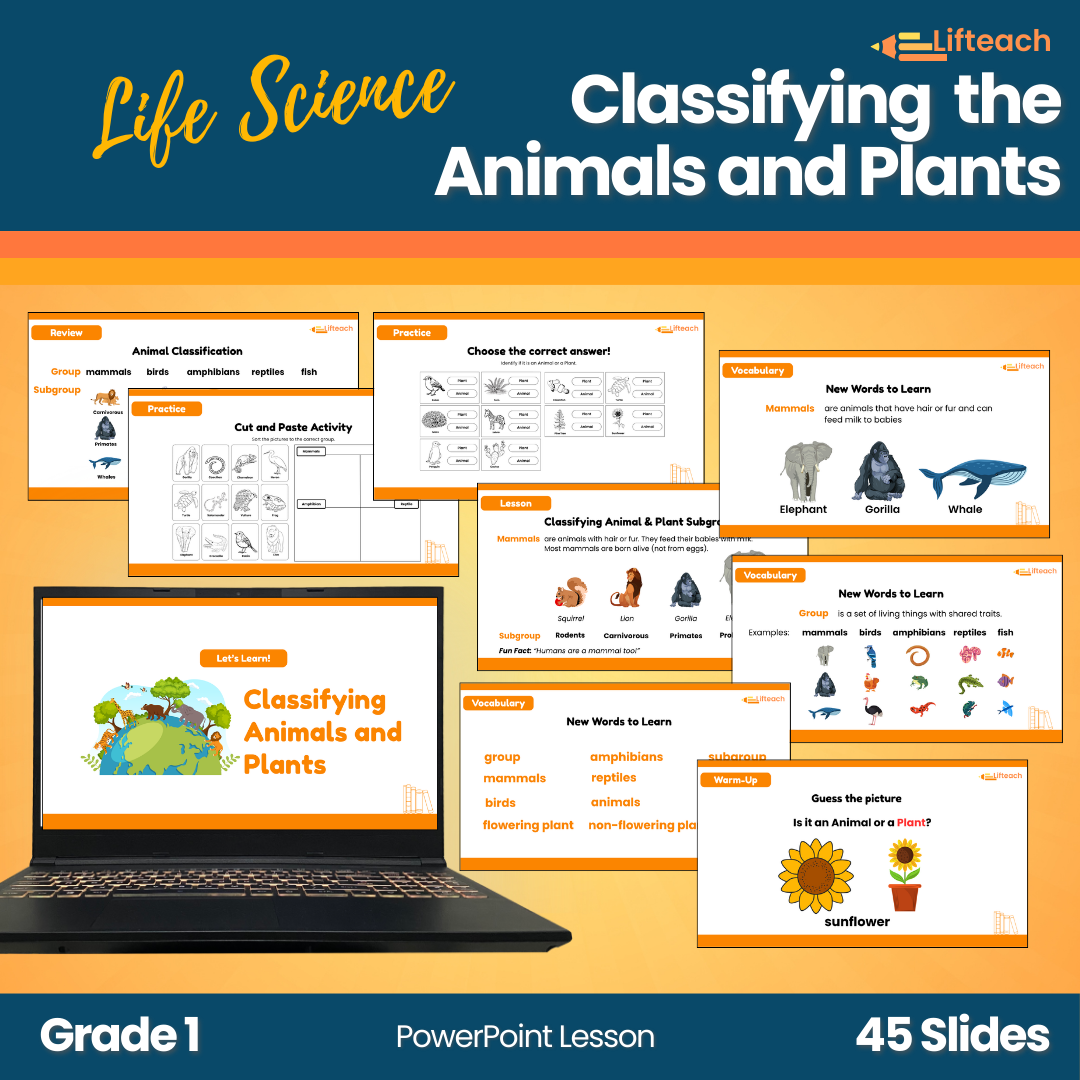
PowerPoint Lesson