Lesson Plan: Adding Three-Digit Numbers
Grade Level: Grade 2
Subject: Math
Duration: 20, 30, or 45 minutes
At a Glance
- Grade: Grade 2
- Duration: 20, 30, or 45 minutes
- Standards: CCSS 2.NBT.B.7 (addition only in this lesson)
- Key materials: Adding Three-Digit Numbers PowerPoint + Worksheet packet; Base-ten blocks (hundreds flats, tens rods, ones cubes) or paper blocks
- Big idea: I can add three-digit numbers with models.
- Unit: Unit 4 Adding and Subtracting Within 1,000 (unit opener)
Lesson Materials
1. Learning Objectives
By the end of this lesson, students will be able to:
- Build two 3-digit numbers with blocks and join them to find the sum.
- Add ones, then tens, then hundreds, and record in a place-value chart.
- Trade 10 ones for 1 ten (or 10 tens for 1 hundred) when needed.
I can add three-digit numbers with models.
2. Standards Alignment
- CCSS 2.NBT.B.7: Add and subtract within 1000, using concrete models or drawings and strategies based on place value, properties of operations, and/or the relationship between addition and subtraction; relate the strategy to a written method. Understand that in adding or subtracting three-digit numbers, one adds or subtracts hundreds and hundreds, tens and tens, ones and ones; and sometimes it is necessary to compose or decompose tens or hundreds.
- Lesson focus: This lesson is addition only. Subtraction comes later in Unit 4.
3. Required Materials & Resources
- Base-ten blocks (hundreds flats, tens rods, ones cubes) or paper blocks
- Place-value mat (H | T | O)
- Whiteboards
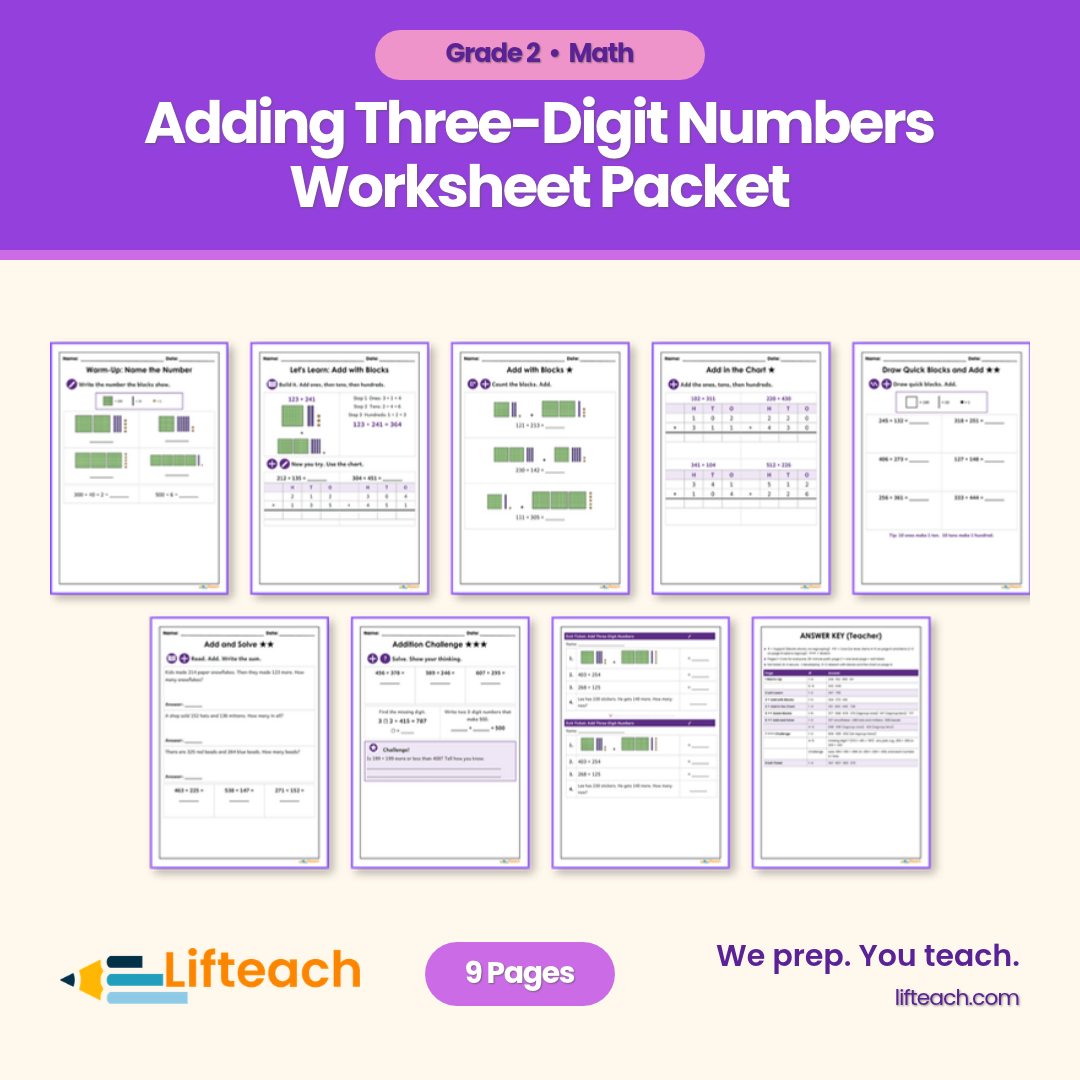
- Adding Three-Digit Numbers Worksheet packet
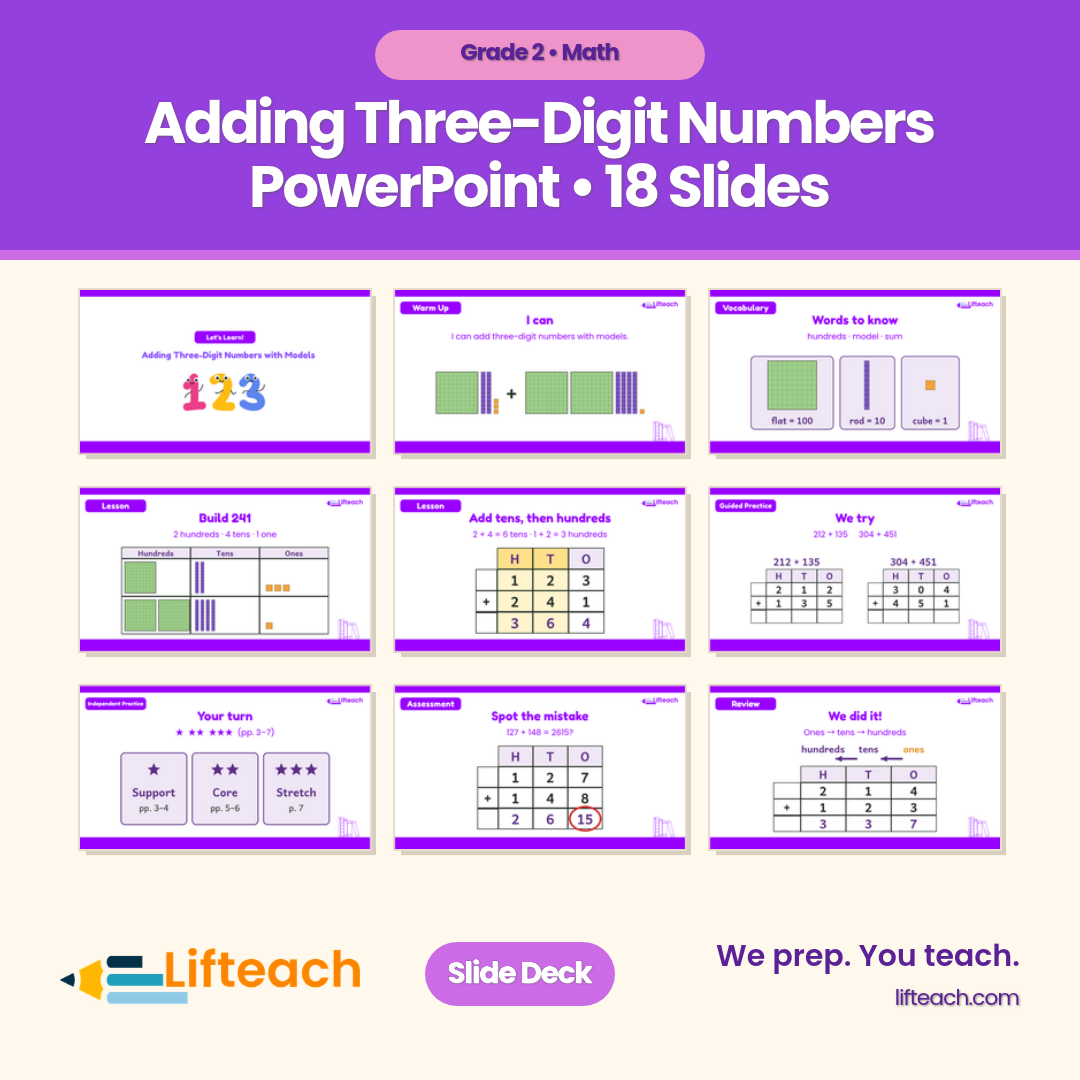
- Adding Three-Digit Numbers PowerPoint
- Lifteach CapCut video hook (play after the hook script on slide 5; pause three times). The YouTube link is not available yet because the video has not been uploaded.
4. Vocabulary
| Word | Meaning |
|---|---|
| Hundreds | Groups of 100; a flat (10 tens). |
| Model | Blocks or a drawing that show a number. |
| Sum | The answer when you add. |
5. Timeline & Lesson Components
Choose the 45-, 30-, or 20-minute path. Times below are in minutes.
| Segment | Slides / pages | 45 min | 30 min | 20 min |
|---|---|---|---|---|
| 1. Hook | Packet p. 1 · slides 1–5 · video | 8 · warm-up p. 1, video with 3 pauses | 5 · warm-up items 1–4, video to pause 2 | 3 · warm-up items 1–2 |
| 2. Teach | Slides 6–11 · blocks on mats | 10 · build 123 + 241; trade 10 ones (127 + 148) | 7 · build 123 + 241 | 5 · 123 + 241 on the board |
| 3. Guided | Packet p. 2 · slides 12–13 | 10 · p. 2 worked example + 2 try-its | 6 · p. 2 | 4 · p. 2 try-it 1 |
| 4. Independent | Slide 14 · pp. 3–7 by level | 12 · ★ pp. 3–4 · ★★ pp. 5–6 · ★★★ p. 7 | 8 · one page per level | 5 · ★ p. 4 / ★★ p. 5 / ★★★ p. 7 |
| 5. Close | Slides 15–18 · p. 8 exit ticket | 5 · regroup trap, exit ticket | 4 · exit ticket | 3 · exit ticket Q1–3 |
Say: “Ones first, then tens, then hundreds.”
Ask: “Do we have 10 or more ones? Then we trade.”
Support pages have no regrouping. Core has 3 regroup items. Stretch regroups twice.
6. Instructional Activities & Strategies
Times in the headings follow the 45-minute path. See the table above for the 30- and 20-minute options.
Warm-Up / Hook 8 min
- Teacher says/does: Students complete Warm-Up: Name the Number (page 1). Play the Lifteach CapCut video hook on slide 5, pausing at about 0:28, 0:35, and 0:58.
- Students do: Write the number each model shows, including 305 and 500 + 6.
Direct Instruction 10 min
- Teacher says/does: Build 123 + 241 with blocks (ones, then tens, then hundreds). Then model a trade of 10 ones (127 + 148).
- Students do: Join the blocks and name the sum.
Guided Practice 10 min
- Teacher says/does: Work Let’s Learn: Add with Blocks (page 2), including the worked example and two try-its.
- Students do: Add with the place-value chart.
Independent Practice 12 min
- Teacher says/does: Send students to a level: Support (pages 3–4, no regrouping), Core (pages 5–6), or Stretch (page 7, regroups twice).
- Students do: Complete their level pages.
Closure & Review 5 min
- Teacher says/does: Spot a regrouping mistake, then students complete the exit ticket (page 8). On the 20-minute path, use questions 1–3 only.
- Students do: Find the trap and show what they know.
7. Starter Check & Video Hook
Use packet page 1 as a starter check, then play the video hook with three pauses.
| # | Starter item (packet p. 1) | Answer |
|---|---|---|
| 1 | Blocks: 2 flats, 3 rods, 4 cubes | 234 |
| 2 | Blocks: 1 flat, 5 rods, 2 cubes | 152 |
| 3 | Blocks: 3 flats, 5 cubes | 305 |
| 4 | Blocks: 4 flats, 1 rod, 1 cube | 411 |
| 5 | 300 + 40 + 2 | 342 |
| 6 | 500 + 6 | 506 |
If most students miss 2 or more: spend 2 extra minutes building 234 on the mat and naming each place before adding.
Before the video: “Watch how the blocks are joined. What gets added first?”
| Pause | Ask | Listen for |
|---|---|---|
| Pause 1 · ~0:28 | How many hundreds, tens, and ones in the first number? | Read from the model. |
| Pause 2 · ~0:35 | What do we add first? | The ones. |
| Pause 3 · ~0:58 | What is the sum? How do the blocks show it? | The sum; count flats, rods, and cubes. |
These pause times match the Lifteach CapCut video plan. Adjust them if the final cut differs. The YouTube link is not available yet; the CapCut video has not been uploaded.
8. Assessment
Exit ticket
| # | Question | Answer |
|---|---|---|
| 1 | Model 132 + 215 | 347 |
| 2 | 403 + 254 | 657 |
| 3 | 268 + 125 | 393 |
| 4 | Lee has 230 stickers and gets 140 more | 370 |
Score bands: Out of 4: 4 secure · 3 developing · 0–2 reteach. On the 20-minute path (questions 1–3): 3 secure · 2 developing · 0–1 reteach.
Reteach: Q1–2 → build both numbers on the mat. Q3 → trade 10 ones for a rod. Q4 → act it out with blocks and write the equation.
9. Worksheets
The source packet is 9 pages (8 student pages + a teacher answer key). Page numbers below are provisional until the final Canva PDF is ready. Adding Three-Digit Numbers Worksheet.
| Level | Pages and task | Answer key |
|---|---|---|
| Support (pages 3–4) | Add with pictured blocks; place-value chart with no regrouping. | 334, 372, 416 / 413, 650, 445, 738 |
| Core (pages 5–6) | Quick blocks (6) and word problems + equations (6). | 377, 569, 679, 275, 617, 777 / 337, 288, 589, 688, 685, 423 |
| Stretch (page 7) | Regroup twice, missing digit, make 500, 199 + 199. | 834, 835, 902, 7, any pair, less (398) |
Page 1 is the warm-up / starter. Page 2 is the guided “Let’s Learn” page. Page 8 is the exit ticket. Page 9 is the teacher answer key.
10. Differentiation & Supports
Common misunderstandings
| If you hear or see | Say instead |
|---|---|
| Adds across places (hundreds + ones) | Line up the places. Add ones with ones, tens with tens, hundreds with hundreds. |
| Writes 15 in the ones place (e.g., 127 + 148 = 2615) | 10 ones make 1 ten. Trade, then write 5 ones and add the new ten. |
| Reads 305 as “thirty-five” | Zero holds the tens place: 3 hundreds, 0 tens, 5 ones. |
Special education supports
- Sentence frames: “___ hundreds + ___ hundreds = ___ hundreds.” · “The sum is ___.”
- Access and response: Real blocks on a color-coded H | T | O mat; read word problems aloud; hundreds chart for checking. Students may build, point, or say; Support pages use pictured blocks. Stamps or stickers may be used for quick blocks on page 5.
- Prompting: Prompting hierarchy: full physical → partial physical → model → gesture → verbal → independent. Record the highest independent level.
IEP Goal Bank connections
| Goal Bank ID | Practiced in |
|---|---|
| ES-ALL-EN21-17 · 2- and 3-digit addition with/without regrouping | pp. 3–7 |
| MC-K3-ADDSUB-01 · combine sets with manipulatives | Teach (blocks) · p. 3 |
| MC-K3-ADDSUB-08 · 2-digit addition without regrouping | Tens + ones steps · p. 4 |
| ES-ALL-EN12-16 · identify place value | Warm-up p. 1 |
| MR-K3-NUMS-12 · one-step story problems | p. 6 · exit Q4 |
UDL
| Principle | In this lesson |
|---|---|
| Engagement | Winter story problems (snowflakes, mittens); choose a level; partner build-and-check. |
| Representation | Blocks, quick drawings, H | T | O chart, and an equation for the same sum; color by place. |
| Action & Expression | Build, draw, or write; whiteboards; explain with a partner (Stretch challenge). |
PowerPoint Lesson