Lesson Plan: Exploring Habitats
Grade Level: Grade 1
Subject: Science
Duration: 55 minutes
At a Glance
- Grade: Grade 1
- Duration: 55 minutes
- Standards: Arizona Science Standards 1.L2U2.7; CCSS.ELA-LITERACY.SL.1.1, RI.1.1, W.1.2
- Key materials: Exploring Habitats PowerPoint + Worksheet Packet; earth materials and a toy frog for the hands-on habitat
- Big idea: Living things use food, water, and shelter from their habitat to grow and survive.
1. Learning Objectives
By the end of this lesson, students will be able to:
- Develop and use simple models (drawings or manipulatives) to show how living things use resources (water, food, and shelter) to grow and survive.
- Design a basic habitat using earth materials (soil, rocks, sticks, leaves) and explain how it meets the needs of a chosen animal.
- Evaluate a peer’s habitat design and suggest one improvement based on resource needs.
2. Standards Alignment
- Arizona Science Standards 1.L2U2.7: “Develop and use models about how living things use resources to grow and survive; design and evaluate habitats for organisms using earth materials.”
- CCSS.ELA-LITERACY.SL.1.1: “Participate in collaborative conversations with diverse partners about grade 1 topics and texts with peers and adults in small and larger groups.”
- CCSS.ELA-LITERACY.RI.1.1: “Ask and answer questions about key details in a text.”
- CCSS.ELA-LITERACY.W.1.2: “Write informative/explanatory texts in which they name a topic, supply some facts about the topic, and provide some sense of closure.”
- NGSS note: Grade 1 NGSS does not have a habitats performance expectation. The closest NGSS connection is K-ESS3-1 (“Use a model to represent the relationship between the needs of different plants or animals (including humans) and the places they live”). Do not label this lesson as 1-LS1-1; that PE is about mimicking plants’ and animals’ external parts.
3. Required Materials & Resources
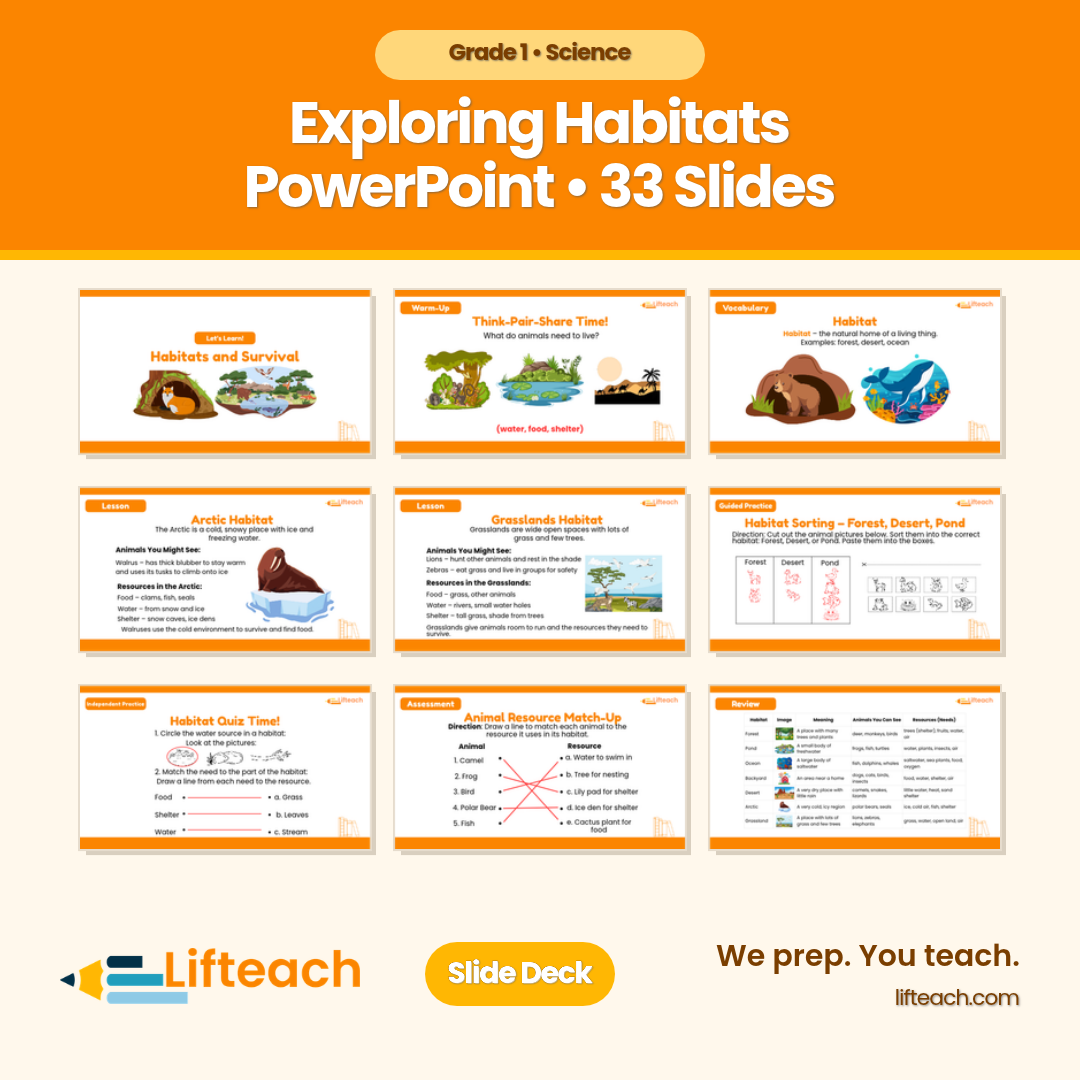
- Exploring Habitats PowerPoint
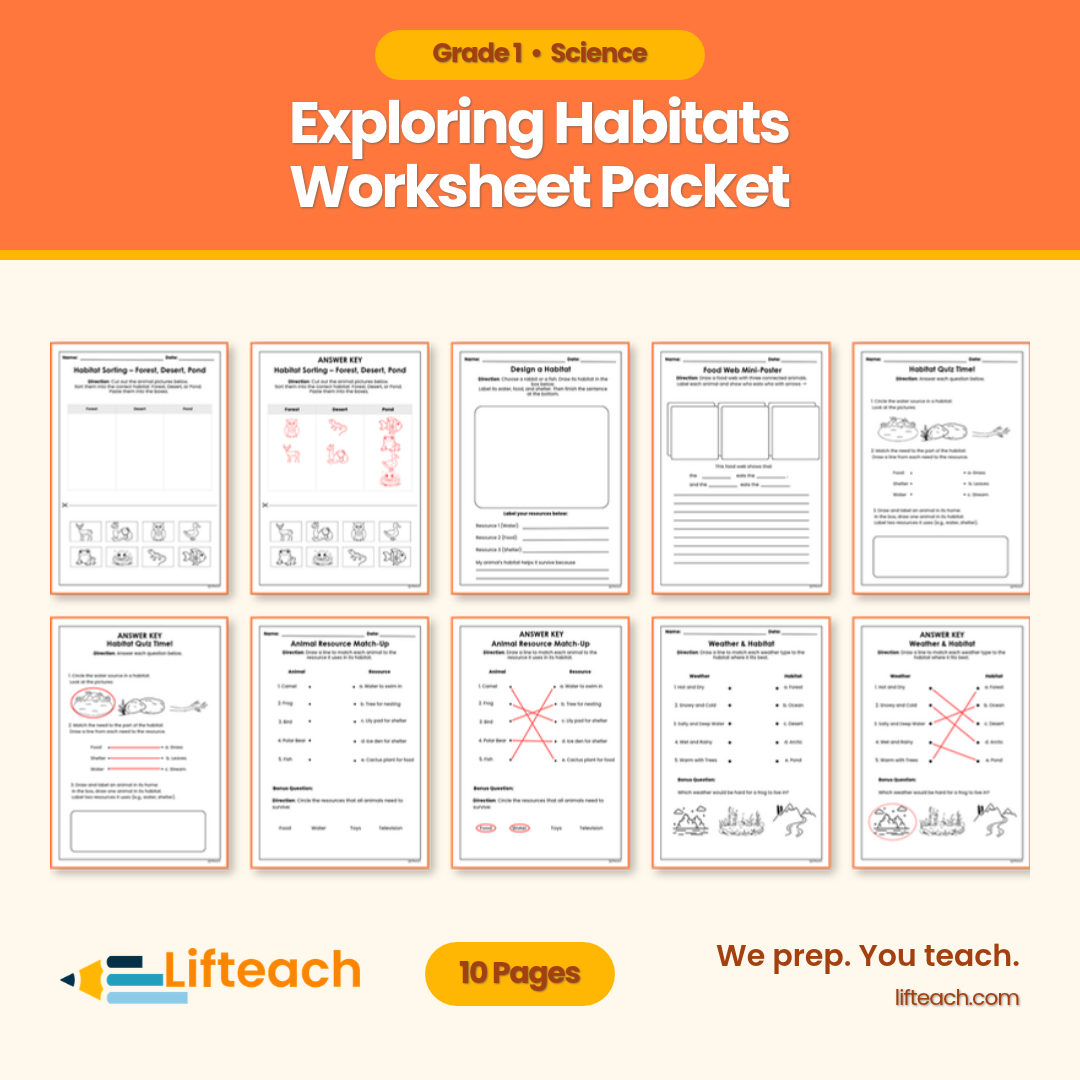
- Exploring Habitats Worksheet Packet (see Section 9: Worksheets)
- Earth materials: small containers of soil, pebbles, sticks, and leaves; a shallow water dish
- Toy animals or printed animal cut-outs (a frog for the group build; optional rabbit and fish pictures for Design a Habitat)
- The picture book A House for Hermit Crab by Eric Carle (or the short retelling on Slides 9)
- Picture cards or slides of a pond, forest, and desert
- Chart paper and markers; construction paper, glue, crayons
- Classroom whiteboard or projector
4. Vocabulary
| Word | Meaning |
|---|---|
| Habitat | The natural home of a living thing. Examples: forest, desert, pond, ocean. |
| Resources | The things a living thing needs to survive, such as food, water, and shelter. |
| Shelter | A safe place to rest or hide, such as a burrow, a nest, a shell, or a cave. |
| Survive | To stay alive and grow. |
5. Timeline & Lesson Components
| Time | Part | What the teacher does | Slides | Worksheet pages |
|---|---|---|---|---|
| 0–5 min | Warm-Up | Think-pair-share with pictures of a pond, a forest, and a desert. Ask, “What do animals need to live?” Listen for water, food, and shelter. | 1–3 | — |
| 5–25 min | Lesson Proper | Quickly teach habitat, resources, and shelter. Model and label a pond habitat. Read or retell A House for Hermit Crab and ask how the crab finds shelter. Take a short picture walk through other habitats if time. Then groups of three build a frog habitat with earth materials and explain each placement. | 4–18 | — |
| 25–40 min | Practice / Design a Habitat | Habitat Sorting (forest, desert, pond), then Design a Habitat: draw and label water, food, and shelter for a rabbit or a fish, and write one sentence about how the habitat helps the animal survive. Peers suggest one improvement. | 19–21 | 1–3 |
| 40–50 min | Test / Habitat Quiz | Students complete Habitat Quiz Time: circle the water source, match each need to a resource, and draw an animal with two labels. | 23–25 | 5–6 |
| 50–55 min | Review & Reflection | Thumbs up/down: “Can you build a habitat for an animal?” Partner share: one resource your animal needs and why. Optional: the slide 26 exit ticket, or the oral exit ticket from the LP (name one habitat resource). | 26, 32–33 | — |
Food Web Mini-Poster (Worksheet page 4; Slide 22) is an extension from the LP’s additional-worksheet list and the advanced-learner suggestion. Animal Resource Match-Up and Weather & Habitat (pages 7–10; Slides 27–31) are follow-up or homework. They will not fit inside the 55-minute lesson.
6. Instructional Activities & Strategies
Warm-Up / Hook 5 min
- Teacher says/does: Show three habitat pictures (pond, forest, desert) on Slides 2–3. Ask, “What do animals need to live?”
- Students do: Think-pair-share. List needs such as water, food, and shelter. Reveal the three words on Slide 3.
Teacher Tip: Keep the share to one need per pair so the 5-minute warm-up stays tight. You’ll come back to the words during vocabulary.
Direct Instruction 20 min
- Teacher says/does: Teach the three vocabulary words on Slides 4–6 (habitat, resources, shelter).
- Teacher says/does: On chart paper and Slides 7–8, draw a simple pond habitat and label water, plants, and shelter.
- Teacher says/does: Read A House for Hermit Crab or use the short retelling on Slide 9. Pause to ask, “How does the crab find shelter?”
- Teacher says/does: If time, take a brief picture walk through other habitats on Slides 10–18. Each habitat slide now uses its own resource heading. Slide 14 lists desert food as cactus, seeds, and insects. Slide 15 is written about the walrus shown in the art (thick blubber, tusks, food from clams, fish, and seals).
- Students do: In groups of three, build a habitat for a toy frog with soil, twigs, leaves, and a water dish. Each group explains why they placed each material.
Teacher Tip: The frog build is the “design and evaluate with earth materials” part of 1.L2U2.7. It is not a worksheet page. Snap a photo or leave the models out for the peer-evaluation step after Design a Habitat.
Guided / Independent Practice 15 min
- Students do: Habitat Sorting – Forest, Desert, Pond (Worksheet page 1; answer key on page 2; Slides 19–20). The turtle is in the Pond column with the fish, frog, and duck.
- Students do: Design a Habitat (Worksheet page 3; Slide 21). Students choose a rabbit or a fish, draw the habitat with water, food, and shelter labeled, and finish the sentence about how the habitat helps the animal survive.
- Students do: Look at a partner’s habitat and suggest one improvement (“It needs more shelter,” “Add a water source”).
Teacher Tip: The Food Web Mini-Poster (page 4) is a good early-finisher or next-day task. It matches the LP’s advanced-learner challenge (add a food-chain arrow) and is not required in this 15-minute block.
Assessment (Habitat Quiz) 10 min
- Teacher says/does: Hand out Habitat Quiz Time! (Worksheet page 5; answer key on page 6; Slides 23–25). The direction is “Answer each question below.”
- Students do: Circle the pond as the water source, match each need to a resource, and draw one animal in its habitat with two resource labels. The matching key is Food ? Grass, Shelter ? Leaves, Water ? Stream.
Closure & Review 5 min
- Teacher says/does: Thumbs up/down: “Do you feel confident you can build a habitat for an animal?”
- Students do: Turn to a partner and say one resource their animal needs and why. If you want a paper exit ticket, use Slide 26 (draw an animal and label two resources) or ask each student to name one habitat resource, as the original plan suggests.
7. Assessment Methods
- Formative: Observation during the frog-habitat build and partner talk; questions during the hermit-crab read-aloud; Habitat Sorting and Design a Habitat work.
- Summative: Habitat Quiz (page 5); a quick check that the design includes three resources and a sentence about how the habitat helps the animal survive.
- Follow-up or homework: Animal Resource Match-Up (pages 7–8) and Weather & Habitat (pages 9–10).
8. Differentiation Strategies
- Struggling Learners / ELLs: Sentence starters such as “My habitat has _____ for water.” Picture cards beside resource words. Allow a drawing or an oral sentence instead of writing.
- Advanced Learners: Add a food-chain arrow or complete the Food Web Mini-Poster (page 4). Use comparative language (“My habitat has more shade than the desert.”).
- Students who need more support: Pair with a peer buddy for labeling; offer a 3-event or pre-labeled resource word bank.
9. Worksheets
| Worksheet | Pages | What’s on it |
|---|---|---|
| Worksheet 1: Habitat Sorting – Forest, Desert, Pond | 1–2 | Cut and paste eight animals into Forest, Desert, or Pond. Answer key included; the turtle is in Pond. |
| Worksheet 2: Design a Habitat | 3 | Students choose a rabbit or a fish, draw a habitat, label water, food, and shelter, and finish a survival sentence. Answers will vary. |
| Worksheet 3: Food Web Mini-Poster | 4 | Draw three connected animals and complete “the _____ eats the _____.” Extension / early finisher. Answers will vary. |
| Worksheet 4: Habitat Quiz Time! | 5–6 | Direction: “Answer each question below.” Circle the water source (pond), match needs to resources (Food ? Grass, Shelter ? Leaves, Water ? Stream), and draw an animal with two labels. Answer key included on page 6. |
| Worksheet 5: Animal Resource Match-Up | 7–8 | Match camel, frog, bird, polar bear, and fish to a resource. Bonus: circle the resources all animals need (food and water). Answer key included and correct. |
| Worksheet 6: Weather & Habitat | 9–10 | Match weather types to habitats; bonus: which weather is hard for a frog (the icy/Arctic picture). Answer key included and correct. |
10. Reflection & Next Steps
- Teacher Reflection: Who can name food, water, and shelter in a habitat they designed? Who still places a pond animal in the desert? Did the peer-evaluation step produce useful improvements?
- Student Reflection: “My favorite part of making habitats was _____.”
PowerPoint Lesson