Lesson Plan: Exploring Feeling and Sensory Words in Stories and Poems
Grade Level: Grade 1
Subject: English Language Arts
Duration: 50 minutes
At a Glance
- Grade: Grade 1
- Duration: 50 minutes
- Standards: CCSS.ELA-LITERACY.RL.1.4
- Key materials: Feeling and Sensory Words PowerPoint + Worksheet Packet
- Big idea: Feeling words show emotions. Sensory words help us see, hear, smell, taste, or touch what is in a story or poem.
1. Learning Objectives
By the end of this lesson, students will be able to:
- Identify words and phrases in a story or poem that suggest feelings (for example, happy, sad, excited).
- Identify words and phrases that appeal to the five senses (sight, sound, smell, taste, touch).
- Explain how a chosen word makes them think of a feeling or a sensory experience.
2. Standards Alignment
- CCSS.ELA-LITERACY.RL.1.4: “Identify words and phrases in stories or poems that suggest feelings or appeal to the senses.”
3. Required Materials & Resources
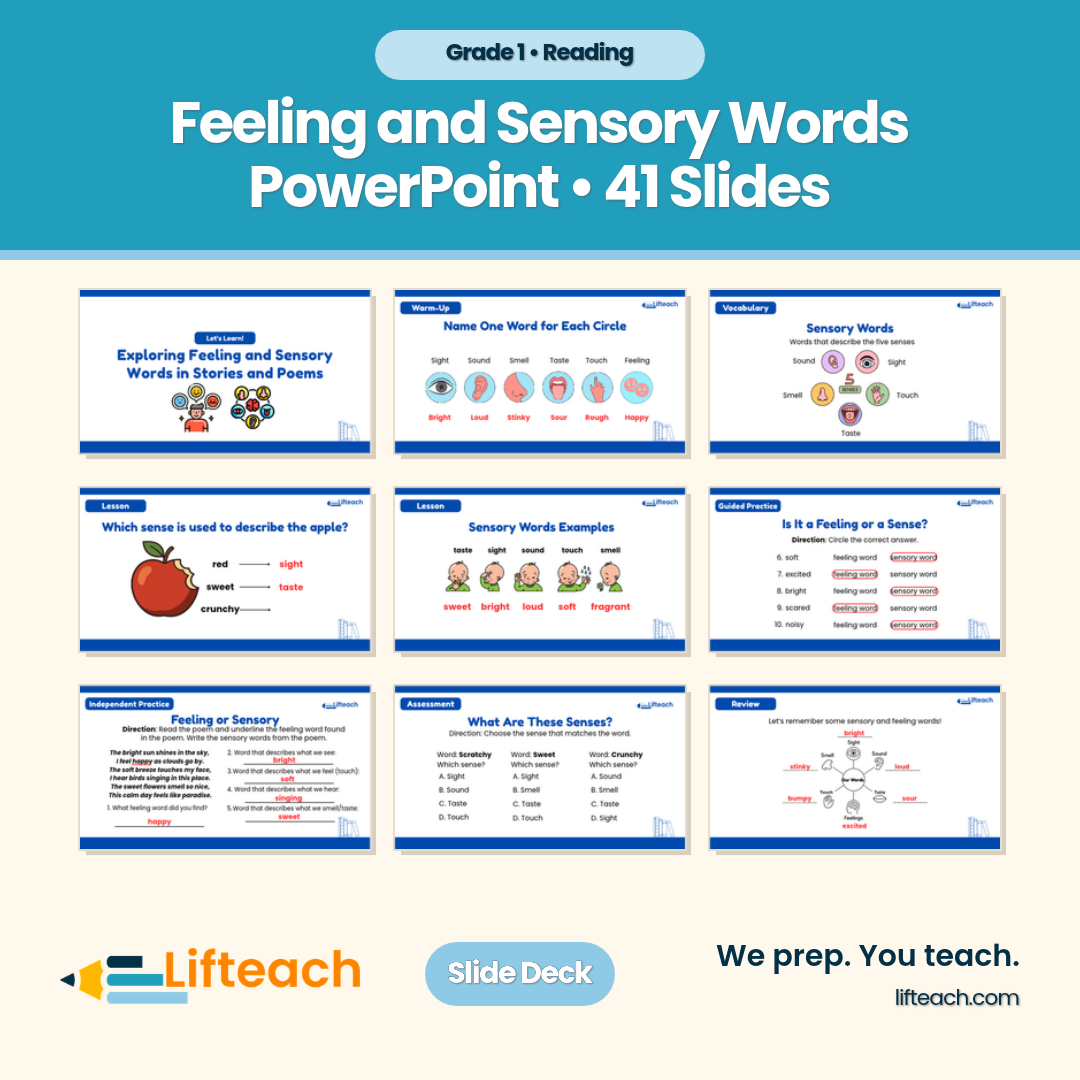
- Exploring Feeling and Sensory Words in Stories and Poems PowerPoint
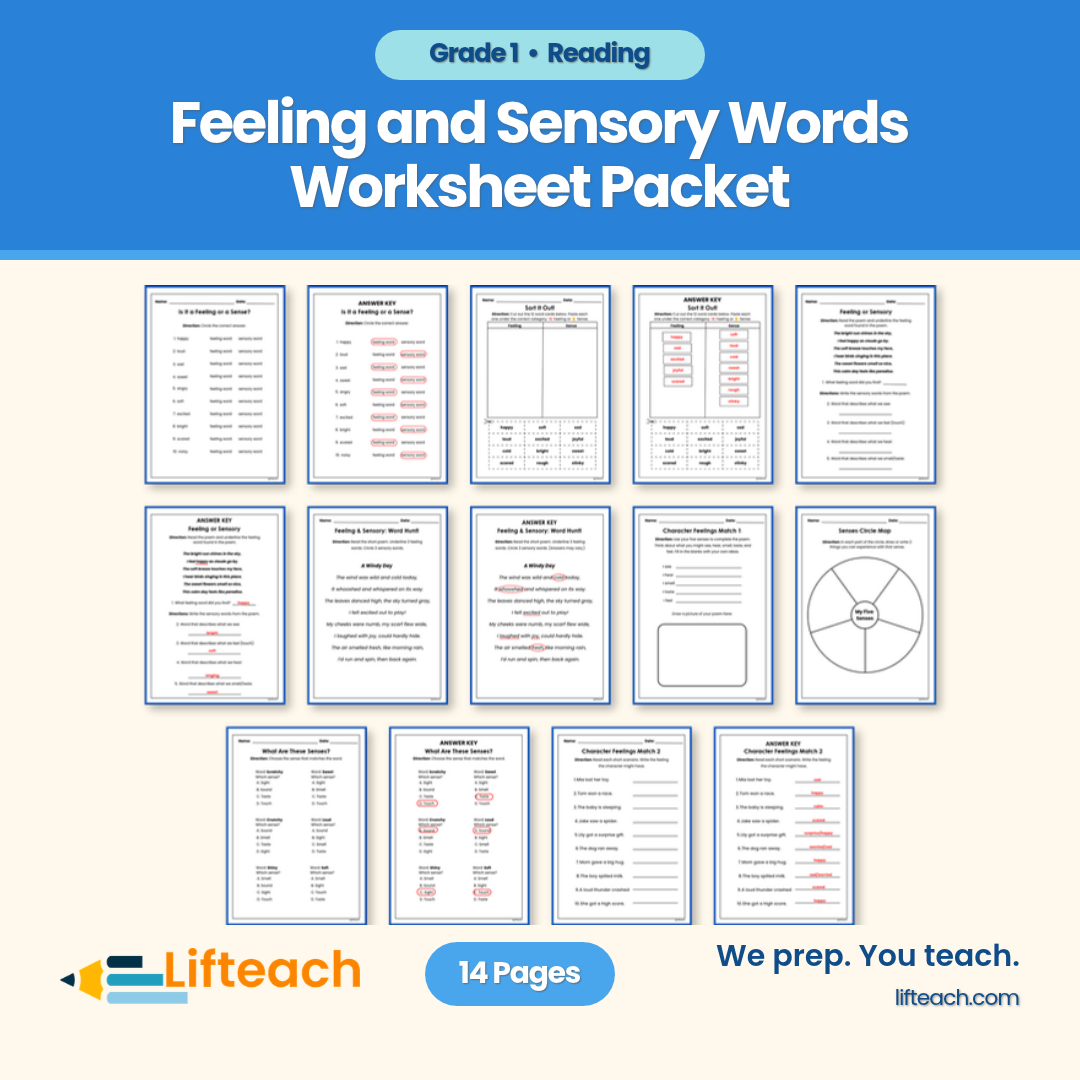
- Feeling and Sensory Words Worksheet Packet (see Section 9: Worksheets). This is a 14-page set (a Word Hunt answer key was added as page 8).
- Chart paper and markers for a Feeling / Senses anchor chart
- The poem “The Crunchy Apple” (on the slides)
- Student whiteboards or the worksheet pages listed in the timeline
- Crayons or colored pencils; scissors and glue for Sort It Out!
- Optional realia: a lemon slice, a cotton ball, a bell
- Projector (optional)
4. Vocabulary
| Word | Meaning |
|---|---|
| Feeling words | Words that show emotions (happy, sad, angry, excited, scared). |
| Sensory words | Words that describe the five senses. |
| Sight | What we see (bright, shiny, red). |
| Sound (hearing) | What we hear (loud, crunchy, noisy). |
| Smell | What we smell (fragrant, stinky, fresh). |
| Taste | What we taste (sweet, sour). |
| Touch | What we feel with our hands or skin (soft, rough, cold). |
5. Timeline & Lesson Components
| Time | Part | What the teacher does | Slides | Worksheet pages |
|---|---|---|---|---|
| 0–10 min | Warm-Up / Vocabulary | Brainstorm one word for sight, sound, smell, taste, touch, and feelings. Teach the two vocabulary terms. | 1–11 | — |
| 10–25 min | Lesson Proper | Read “The Crunchy Apple.” Think aloud: crunchy (sound), sweet (taste), red/bright (sight), delighted or smile (feeling). Record examples on the anchor chart. | 12–18 | — |
| 25–35 min | Guided Practice | Is It a Feeling or a Sense? then Sort It Out! (cut and paste feeling vs. sense words). | 19–24 | 1–4 |
| 35–45 min | Independent Practice | Underline feeling words and hunt for sensory words in short poems (answer keys on pages 6 and 8). Optional five-senses fill-in poem is page 9. | 25–28 | 5–9 |
| 45–50 min | Closure & Review | Senses Circle Map if started, then a sticky-note exit ticket: one new feeling or sensory word. | 29–30 | 10 |
Assessment pages (What Are These Senses? and Character Feelings Match 2; Slides 31–40, Worksheet pages 11–14) can be used as a follow-up check or homework.
6. Instructional Activities & Strategies
Warm-Up / Hook 10 min
- Teacher says/does: On chart paper (and Slides 2–9), draw five circles labeled Sight, Sound, Smell, Taste, and Touch, plus a sixth circle labeled Feelings. Call on volunteers to name one word for each.
- Teacher says/does: The modeled warm-up now includes one word for each sense and a feeling: Bright, Loud, Stinky, Sour, Rough, and Happy.
- Teacher says/does: Introduce the goal: “We are word detectives hunting for feeling words and sensory words in a poem.” Teach the two vocabulary terms (Slides 10–11).
Teacher Tip: Real objects help: pass around a cotton ball (soft / touch), ring a bell (sound), or show a lemon (smell or sour taste).
Direct Instruction 15 min
- Teacher says/does: Display and read “The Crunchy Apple” (Slide 12).
- Teacher says/does: Think aloud on Slides 13–16 (“Which sense is used to describe the apple?”). Highlight crunchy (sound), sweet (taste), and red / bright (sight). Point out a feeling too (smile / yummy / delighted, depending on the line you emphasize).
- Teacher says/does: Add examples to the anchor chart from Slides 17–18 (happy, sad, angry, excited; bright, loud, sweet, soft, fragrant).
- Students do: Name the sense or feeling for each highlighted word.
Guided Practice 10 min
- Students do: Is It a Feeling or a Sense? (Worksheet page 1; answer key on page 2; Slides 19–22): circle feeling word or sensory word for 10 items.
- Students do: Sort It Out! (Worksheet page 3; answer key on page 4; Slides 23–24): cut out 12 word cards and paste them under Feeling or Sense.
Teacher Tip: Keep the answer keys (pages 2, 4, 6, 8, 12, and 14) until students have finished the matching student pages.
Independent Practice 10 min
- Students do: Feeling or Sensory (Worksheet page 5; answer key on page 6; Slides 25–26): underline the feeling word in the poem and write sensory words for see, touch, hear, and smell/taste.
- Students do: Feeling & Sensory: Word Hunt! (Worksheet page 7; answer key on page 8; Slide 27): underline 3 feeling words and circle 3 sensory words in “A Windy Day.” The key notes that answers may vary. A sample set is feeling: excited, joy; sensory: cold, whooshed, fresh.
- If early finishers: Character Feelings Match 1 is a five-senses fill-in poem (Worksheet page 9; Slide 28). Answers will vary.
Closure & Review 5 min
- Students do: Start the Senses Circle Map (Worksheet page 10; Slide 29) if time, or save it for later: draw or write two things for each sense.
- Students do: Sticky-note exit ticket (Slide 30): one new feeling word or sensory word, then a quick thumbs-up/thumbs-down: “Do you feel more confident finding these words?”
7. Assessment Methods
- Formative: Warm-up contributions; Sort It Out accuracy; poem underlining; exit ticket.
- Summative (follow-up or homework):
- What Are These Senses? (pages 11–12): choose the sense that matches each word.
- Character Feelings Match 2 (pages 13–14): write the feeling a character might have. Sample key: lost toy — sad; won a race — happy; baby sleeping — calm; saw a spider — scared.
8. Differentiation Strategies
- Struggling Learners / ELLs: Provide a word bank; pair with a stronger reader; keep picture icons beside each sense; pre-teach feeling words with emoji cards.
- Advanced Learners: Find extra feeling or sensory words in a second short poem, or write a sentence that uses one feeling word and one sensory word.
- Kinesthetic Learners: Act out a feeling or sensory word in charades before writing it down.
9. Worksheets
| Worksheet | Pages | What’s on it |
|---|---|---|
| Worksheet 1: Is It a Feeling or a Sense? | 1–2 | Circle feeling word or sensory word for 10 items. Answer key included on page 2. |
| Worksheet 2: Sort It Out! | 3–4 | Cut and paste 12 words under Feeling or Sense. Answer key included on page 4. |
| Worksheet 3: Feeling or Sensory / Word Hunt! | 5–8 | Underline and list words from two short poems. Answer keys are on pages 6 and 8 (Word Hunt answers may vary). |
| Worksheet 4: Character Feelings Match 1 / Senses Circle Map | 9–10 | Five-senses fill-in poem and a circle map. Answers will vary. |
| Worksheet 5: What Are These Senses? / Character Feelings Match 2 | 11–14 | Choose the matching sense; write a character’s feeling. Answer keys included on pages 12 and 14. |
10. Reflection & Next Steps
- Teacher Reflection: Do students still mix up a feeling (happy) with a sense word that describes a mood (warm, soft)? Who needs more work on smell vs. taste?
- Student Reflection: “Which sense was easiest to find in the poems today?”
PowerPoint Lesson