Lesson Plan: Irregular Plural Nouns
Grade Level: Grade 2
Subject: English Language Arts
Duration: 50 minutes
At a Glance
- Grade: Grade 2
- Duration: 50 minutes
- Standards: CCSS.ELA-LITERACY.L.2.1.B
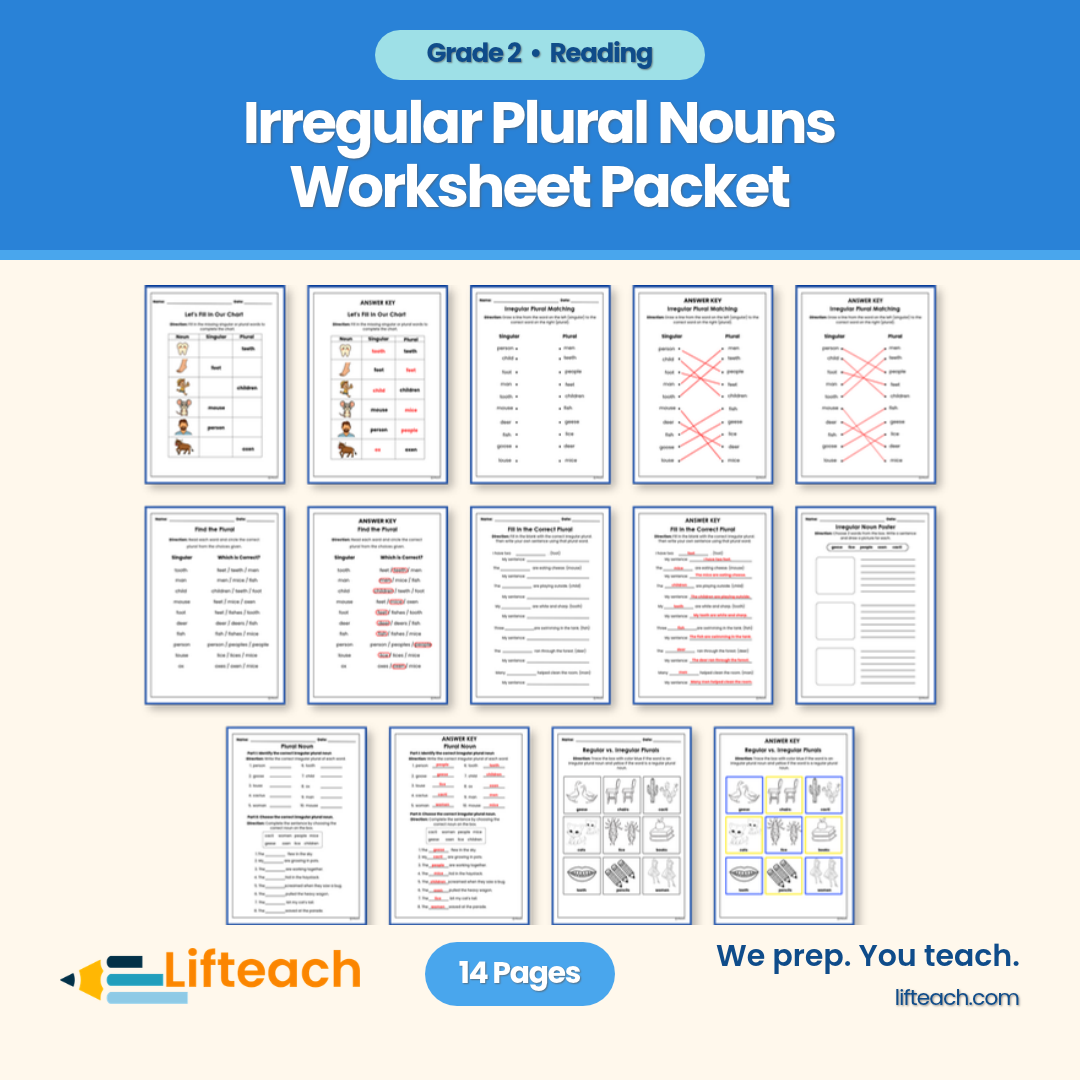
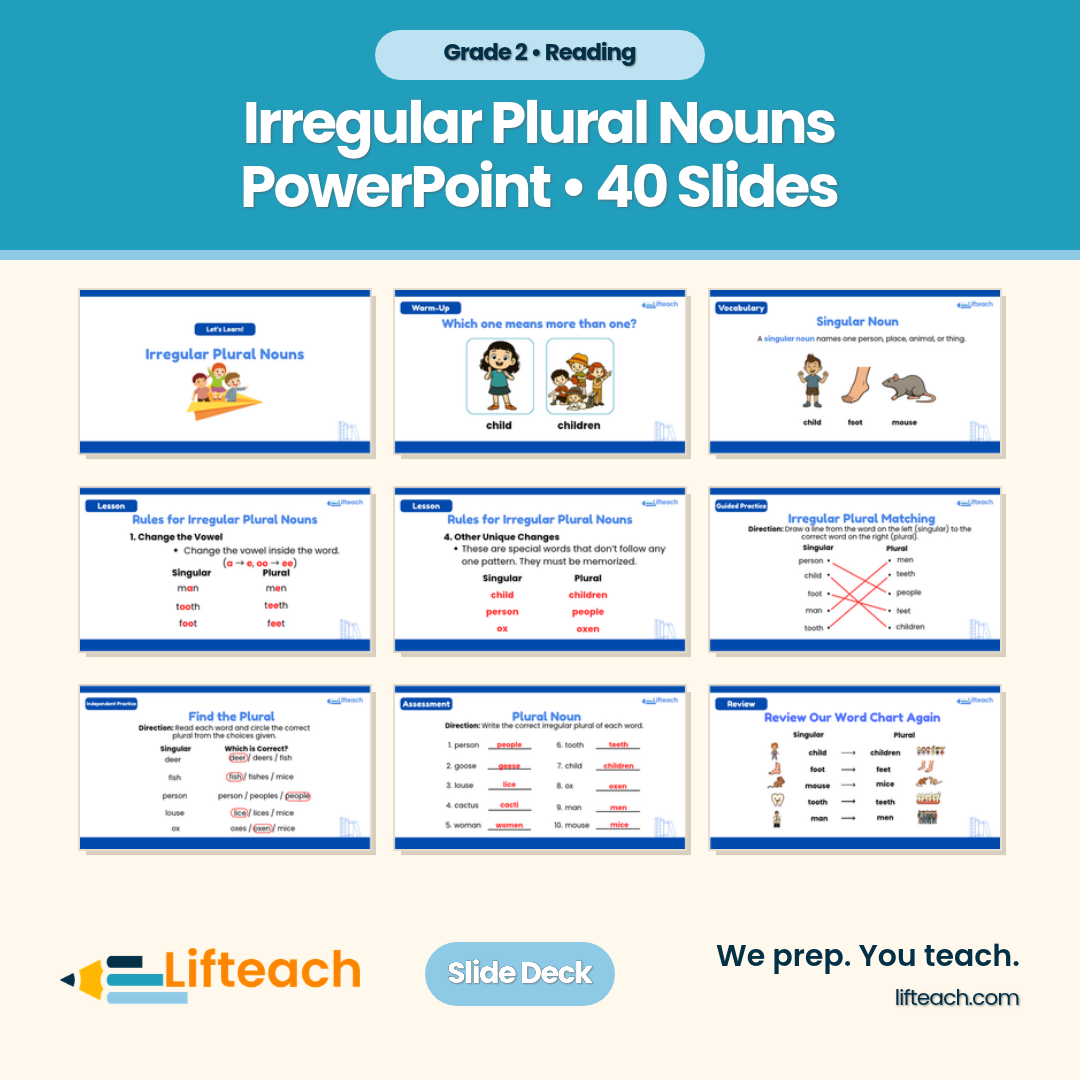
- Key materials: Irregular Plural Nouns PowerPoint + Worksheet Packet
- Big idea: Some plural nouns do not add –s or –es. We have to learn their special forms, such as children, feet, mice, and fish.
1. Learning Objectives
By the end of this lesson, students will be able to:
- Identify common irregular singular/plural noun pairs.
- Form the correct irregular plural for a given singular noun.
- Use irregular plural nouns accurately in spoken and written sentences.
2. Standards Alignment
- CCSS.ELA-LITERACY.L.2.1.B: “Form and use frequently occurring irregular plural nouns (e.g., feet, children, teeth, mice, fish).”
3. Required Materials & Resources
- Irregular Plural Nouns PowerPoint
- Irregular Plural Nouns Worksheet Packet (see Section 9: Worksheets)
- Flashcards (singular noun on one side, picture on the other)
- Chart paper with a two-column Singular / Plural chart
- Sticky notes for the exit ticket
- Pencils, crayons, scissors (for any cut items)
- Projector (optional)
4. Vocabulary
| Word | Meaning |
|---|---|
| Singular noun | Names one person, place, animal, or thing (child, foot, mouse). |
| Plural noun | Names more than one person, place, animal, or thing (children, feet, mice). |
| Irregular plural noun | A plural that does not follow the usual rule of adding –s or –es. The spelling may change, or the word may stay the same. |
Core pairs to teach (Slides 6–13 and the class chart): child/children, foot/feet, mouse/mice, tooth/teeth, man/men, fish/fish, plus later examples such as deer/deer, goose/geese, person/people, and (for a challenge) louse/lice, ox/oxen, cactus/cacti.
5. Timeline & Lesson Components
| Time | Part | What the teacher does | Slides | Worksheet pages |
|---|---|---|---|---|
| 0–10 min | Warm-Up / Vocabulary | Show “child” and “children.” Ask, “What’s different? Which one means more than one?” Teach singular, plural, and the first irregular pairs. | 1–6 | — |
| 10–25 min | Lesson Proper | Explain that irregular plurals do not just add –s or –es. Teach the patterns: change the vowel (man/men, tooth/teeth); change the ending (mouse/mice); stay the same (fish, deer, sheep); other unique changes (child/children, person/people). | 7–13 | — |
| 25–35 min | Guided Practice | Let’s Fill In Our Chart, then Irregular Plural Matching. | 14–19 | 1–4 |
| 35–45 min | Independent Practice | Find the Plural (circle the correct form) and Fill in the Correct Plural (then write a sentence). | 20–27 | 6–9 |
| 45–50 min | Closure & Review | Irregular Noun Poster if time, then a sticky-note exit ticket: “Today I learned the plural of _____. One thing I found tricky was _____.” | 28–29 | 10 |
Assessment pages (Plural Noun Parts I–II and Regular vs. Irregular Plurals; Slides 30–39, Worksheet pages 11–14) can be used as a follow-up check or homework. They will not fit inside the 50-minute lesson.
6. Instructional Activities & Strategies
Warm-Up / Hook 10 min
- Teacher says/does: Display “child” and “children.” Ask, “What’s different about these words? Which one means more than one?” Think-pair-share (Slides 2–3).
- Teacher says/does: Teach singular and plural (Slides 4–6). Record the first pairs on the class chart: child/children, foot/feet, mouse/mice, tooth/teeth, man/men, fish/fish.
- Students do: Repeat each pair and hold up a sticky note or finger for “one” vs. “more than one.”
Teacher Tip: Pronounce each pair clearly and have students chorally repeat. Irregular forms are learned by hearing them often, not only by a rule.
Direct Instruction 15 min
- Teacher says/does: Write “mouse” and think aloud how the ending changes to “mice.” Repeat with “tooth” ? “teeth” (the vowel changes).
- Teacher says/does: Walk through the four patterns on Slides 9–13: change the vowel, change the ending, stay the same, and other unique changes.
- Students do: Together convert “man” ? “men” and “child” ? “children,” holding up the matching card or sticky note.
Guided Practice 10 min
- Students do: Let’s Fill In Our Chart (Worksheet pages 1–2; Slides 14–15): fill in the missing singular or plural.
- Students do: Irregular Plural Matching (Worksheet page 3; answer key on page 4; Slides 16–19): draw a line from each singular noun to its plural. Page 5 is a second copy of the page 4 answer key; do not hand it to students.
Teacher Tip: Use page 4 as the matching answer key. Page 5 is a duplicate of that key. Keep both key pages until students finish page 3.
Independent Practice 10 min
- Students do: Find the Plural (Worksheet page 6; answer key on page 7; Slides 20–23): circle the correct plural.
- Students do: Fill in the Correct Plural (Worksheet pages 8–9; Slides 24–27): complete each sentence and write one sentence of their own using that plural.
Closure & Review 5 min
- Students do: If time, Irregular Noun Poster (Worksheet page 10; Slide 28): choose 3 words from the box (geese, lice, people, oxen, cacti), write a sentence, and draw a picture.
- Students do: Sticky-note exit ticket (Slide 29): “Today I learned the plural of _____. One thing I found tricky was _____.” Park the notes on the board as students leave.
7. Assessment Methods
- Formative: Chart and matching work; sentence writing; exit tickets.
- Summative (follow-up or homework):
- Plural Noun: write the irregular plural and choose the correct word to complete a sentence (pages 11–12).
- Regular vs. Irregular Plurals: color irregular plurals blue and regular plurals yellow (pages 13–14).
8. Differentiation Strategies
- Struggling Learners: Leave a word bank on the page; partner with a buddy; use toys or pictures (a mouse, a foot) to keep meaning attached to the word.
- Advanced Learners: Find two more irregular plurals (for example, ox/oxen, cactus/cacti) and write a short paragraph using at least three irregular plurals.
9. Worksheets
| Worksheet | Pages | What’s on it |
|---|---|---|
| Worksheet 1: Let’s Fill In Our Chart | 1–2 | Complete missing singular or plural forms. Answer key included. |
| Worksheet 2: Irregular Plural Matching | 3–5 | Draw a line from each singular noun to its plural. Page 3 is the student page; page 4 is the answer key; page 5 is a duplicate of the page 4 key. |
| Worksheet 3: Find the Plural / Fill in the Correct Plural | 6–9 | Circle the correct plural, then fill in a sentence and write one of their own. Answer keys included on pages 7 and 9. |
| Worksheet 4: Irregular Noun Poster | 10 | Choose 3 challenge words, write a sentence, and draw. Answers will vary. |
| Worksheet 5: Plural Noun / Regular vs. Irregular | 11–14 | Write or choose irregular plurals, then color regular vs. irregular. Answer keys included on pages 12 and 14. |
10. Reflection & Next Steps
- Teacher Reflection: Which patterns (vowel change vs. no-change words like fish) still need practice?
- Student Reflection: “Which irregular plural was the trickiest for you today?”
PowerPoint Lesson