Lesson Plan: Growing with Plants: Understanding Their Needs
Grade Level: Grade 1
Subject: Science
Duration: 50 minutes
At a Glance
- Grade: Grade 1
- Duration: 50 minutes
- Standards: NGSS 1-LS1-1; CCSS.ELA-LITERACY.RI.1.4 (supporting)
- Key materials: Growing with Plants PowerPoint + Worksheet Packet; a live potted plant if possible
- Big idea: Plants need air, water, light, and soil (minerals) to grow and stay healthy.
1. Learning Objectives
By the end of this lesson, students will be able to:
- Name the four basic needs of plants: air, water, soil (minerals), and light.
- Describe how each need helps a plant grow.
- Identify basic plant parts (roots, stem, leaves, flower, fruit) and tell what they do.
2. Standards Alignment
- NGSS 1-LS1-1: “Use materials to design a solution to a human problem by mimicking how plants and/or animals use their external parts to help them survive, grow, and meet their needs.” This lesson focuses on the plant-needs and plant-parts ideas in that standard.
- CCSS.ELA-LITERACY.RI.1.4: “Ask and answer questions to help determine or clarify the meaning of words and phrases in a text.”
3. Required Materials & Resources
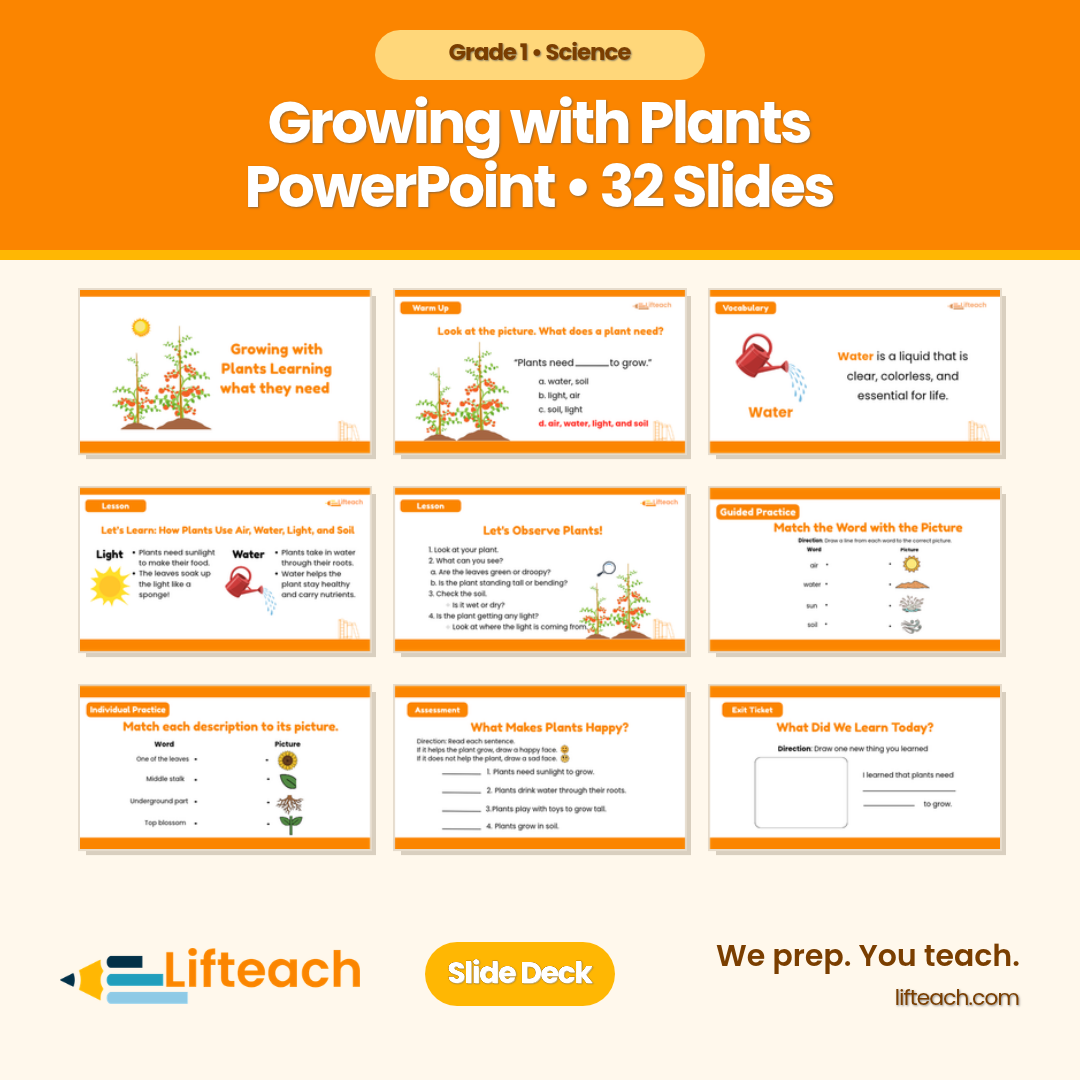
- Growing with Plants: Understanding Their Needs PowerPoint
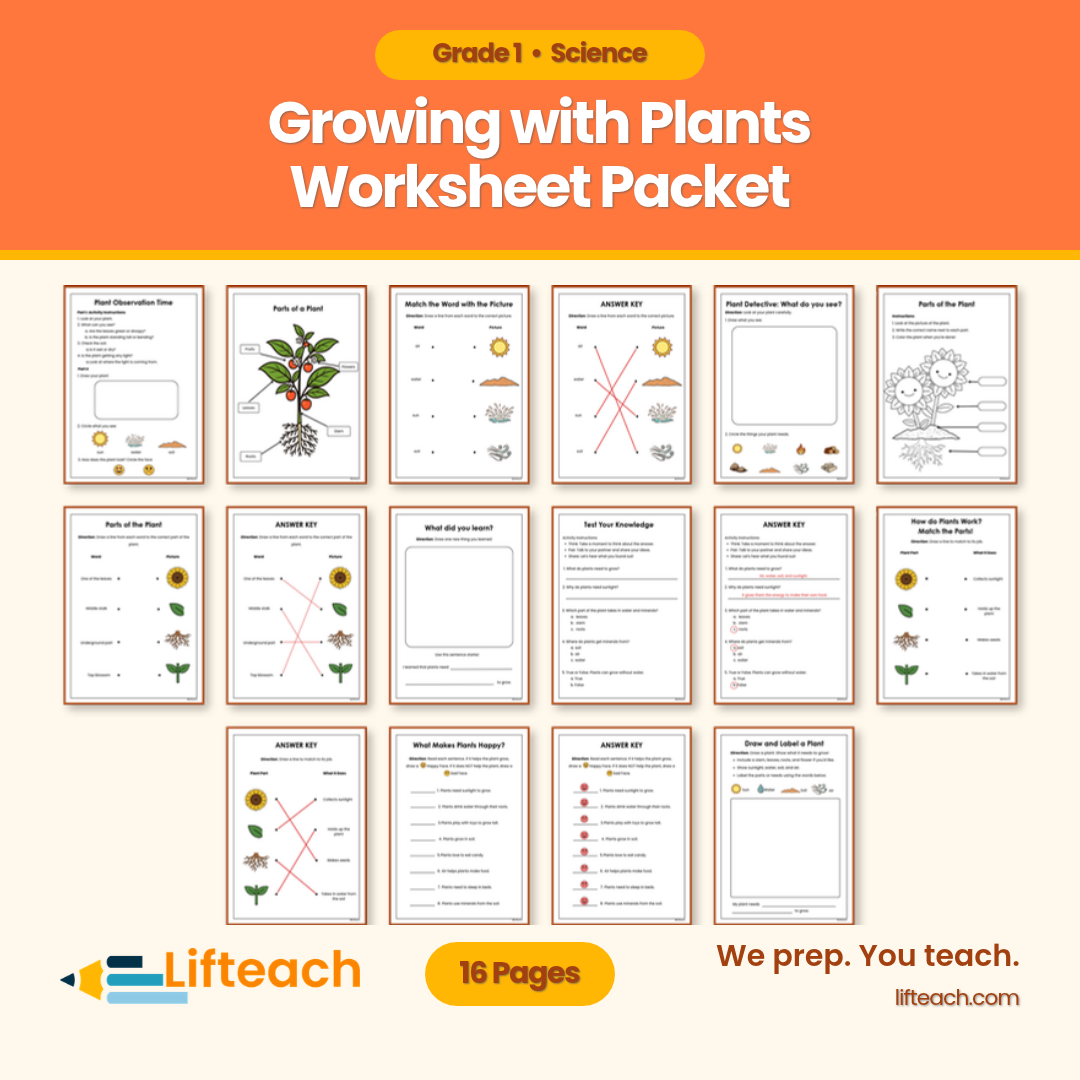
- Growing with Plants Worksheet Packet (see Section 9: Worksheets)
- A live potted plant (or a clear cup, soil, and a seedling)
- Picture cards for air, water, light, and soil
- Crayons, scissors, and glue sticks
- Sticky notes for the exit ticket
- Projector (optional)
4. Vocabulary
| Word | Meaning |
|---|---|
| Air | The invisible gas around us. Plants take in air through tiny holes in their leaves to help them make food and grow. |
| Water | A liquid plants take in through their roots. Water helps the plant stay healthy and carry nutrients. |
| Soil | The ground a plant grows in. Soil holds the plant in place and gives it minerals, like vitamins for the plant. |
| Light (sunlight) | Energy from the sun. Plants need sunlight to make their food. The leaves soak up the light like a sponge. |
5. Timeline & Lesson Components
| Time | Part | What the teacher does | Slides | Worksheet pages |
|---|---|---|---|---|
| 0–10 min | Warm-Up / Vocabulary | Think-pair-share with a potted plant: “What does this plant need to stay healthy?” Teach air, water, soil, and light (Slides 4–8). Fix Slide 9 before teaching that slide. | 1–8 | — |
| 10–20 min | Lesson Proper | How plants use each need; observe a real plant (look, check soil, find the light); name plant parts (roots, stem, leaves, flower, fruit). | 9–16 | 1–2 |
| 20–30 min | Guided Practice | Match each word (air, water, sun, soil) to its picture. | 17–18 | 3–4 |
| 30–40 min | Independent Practice | Plant Detective: draw the plant and circle what it needs. Then label or match plant parts. | 19–22 | 5–8 |
| 40–50 min | Closure & Review | Test Your Knowledge as a think-pair-share if time, then the exit ticket: “I learned that plants need _____ to grow.” | 23–25 | 9–11 |
Assessment pages (How do Plants Work? / What Makes Plants Happy? / Draw and Label; Slides 26–32, Worksheet pages 12–16) can be used as a follow-up check or homework.
6. Instructional Activities & Strategies
Warm-Up / Hook 10 min
- Teacher says/does: Show a small potted plant. Ask: “What do you think this plant needs to stay healthy?” Students think-pair-share.
- Teacher says/does: After the Canva fix, use Slide 3 only if option D includes all four needs (air, water, light, and soil). Do not teach option D as written (“water, light, and soil”), because it leaves out air.
- Teacher says/does: Teach the four vocabulary words with Slides 4–8. Save Slide 9 until Water has the correct definition.
- Students do: Name at least one plant need and repeat the four words.
Teacher Tip: If you do not have a live plant, use a clear photo of a classroom plant and still walk through the observation questions: leaves, stem, soil, and light.
Direct Instruction 10 min
- Teacher says/does: On Slides 9–11, explain how each need helps a plant. After the fix, Water should say that plants take in water through their roots, not that “leaves soak up the light.”
- Students do: Plant Observation Time (Worksheet page 1; also Slides 12–13): look at the plant, check the soil, notice the light, draw the plant, and circle sun, water, and soil.
- Teacher says/does: Name the parts of a plant on Slides 14–16 and Worksheet page 2: roots take in water and minerals; the stem carries water and food; leaves use sunlight and air; the flower makes seeds; the fruit protects the seeds.
Guided Practice 10 min
- Students do: Match the Word with the Picture (Worksheet page 3; answer key on page 4): draw a line from air, water, sun, and soil to the matching picture.
- Teacher says/does: Review as a class on Slides 17–18.
Teacher Tip: For ELLs, hold up the real object or icon (a watering can, a handful of soil) as they match each word.
Independent Practice 10 min
- Students do: Plant Detective (Worksheet page 5; Slides 19–20): draw what they see and circle what the plant needs.
- Students do: Parts of the Plant (Worksheet pages 6–8; Slides 21–22): label the plant or match “one of the leaves,” “middle stalk,” “underground part,” and “top blossom.”
Closure & Review 10 min
- Teacher says/does: If time, do Test Your Knowledge (Worksheet pages 10–11; Slides 23–24) as a think-pair-share. After the Canva fix, the model answer for “What do plants need to grow?” should be the four taught needs: air, water, soil, and sunlight (not “space”).
- Students do: Exit ticket (Worksheet page 9; Slide 25): draw one thing they learned and complete “I learned that plants need _____ to grow.”
Teacher Tip: The Happy Face / Match the Parts assessment pages work well the next day as a quick check. They are not required to close this 50-minute lesson.
7. Assessment Methods
- Formative: Observation during the plant observation and matching pages; exit ticket sentence.
- Summative (follow-up or homework):
- How do Plants Work? Match the Parts! (pages 12–13)
- What Makes Plants Happy? (pages 14–15): happy face if it helps the plant, sad face if it does not. (1 happy, 2 happy, 3 sad, 4 happy, 5 sad, 6 happy, 7 sad, 8 happy)
- Draw and Label a Plant (page 16): show sunlight, water, soil, and air.
8. Differentiation Strategies
- Struggling Learners / ELLs: Provide picture-word cards; pair with a buddy; use the sentence frame “Plants need _____.”
- Advanced Learners: Write two sentences explaining one plant need, or draw a mini comic of a plant that is missing water or light.
9. Worksheets
| Worksheet | Pages | What’s on it |
|---|---|---|
| Worksheet 1: Plant Observation Time | 1 | Look, check the soil and light, and record what the plant looks like. |
| Worksheet 2: Parts of a Plant | 2 | Labeled diagram: fruits, flowers, leaves, stem, roots. |
| Worksheet 3: Match the Word with the Picture | 3–4 | Match air, water, sun, and soil to pictures. Answer key included. |
| Worksheet 4: Plant Detective | 5 | Draw the plant and circle what it needs. |
| Worksheet 5: Parts of the Plant | 6–8 | Label a plant, then match part descriptions to the picture. Answer key included for the matching page. |
| Worksheet 6: What Did You Learn? / Test Your Knowledge | 9–11 | Exit ticket sentence plus five review questions. Answer key included. |
| Worksheet 7–9: Assessment | 12–16 | Match plant parts to their jobs, happy/sad faces, and draw-and-label. Answer keys included where answers are fixed. |
10. Reflection & Next Steps
- Teacher Reflection: Can every student name all four needs? Who still mixes up roots and leaves?
- Student Reflection: “Which plant need will you help with at home or in our classroom?”
PowerPoint Lesson