Lesson Plan: Understanding Key Details Through Who, What, Where, When, Why, and How
Grade Level: Grade 2
Subject: English Language Arts
Duration: 50 minutes
At a Glance
- Grade: Grade 2
- Duration: 50 minutes
- Standards: CCSS.ELA-LITERACY.RL.2.1
- Key materials: Understanding Key Details PowerPoint + Worksheet Packet
- Big idea: Asking who, what, where, when, why, and how helps us find the most important details in a story.
1. Learning Objectives
By the end of this lesson, students will be able to:
- Define the question words who, what, where, when, why, and how.
- Ask and answer each question word about a short story.
- Show understanding of key details by answering in complete sentences.
2. Standards Alignment
- CCSS.ELA-LITERACY.RL.2.1: “Ask and answer such questions as who, what, where, when, why, and how to demonstrate understanding of key details in a text.”
3. Required Materials & Resources
- Understanding Key Details Through Who, What, Where, When, Why, and How PowerPoint
- Understanding Key Details Worksheet Packet (see Section 9: Worksheets)
- Question-word cards (who, what, where, when, why, how)
- Mini-whiteboards and dry-erase markers
- Chart paper or whiteboard
- Pencils; highlighters or colored pencils
- Projector (optional)
4. Vocabulary
| Word | Meaning |
|---|---|
| Who | The person or character in the story. |
| What | The action or event; what is happening. |
| Where | The place or setting of the action. |
| When | The time the event happens. |
| Why | The reason something happens. |
| How | The way something is done or the way a problem is solved. |
5. Timeline & Lesson Components
| Time | Part | What the teacher does | Slides | Worksheet pages |
|---|---|---|---|---|
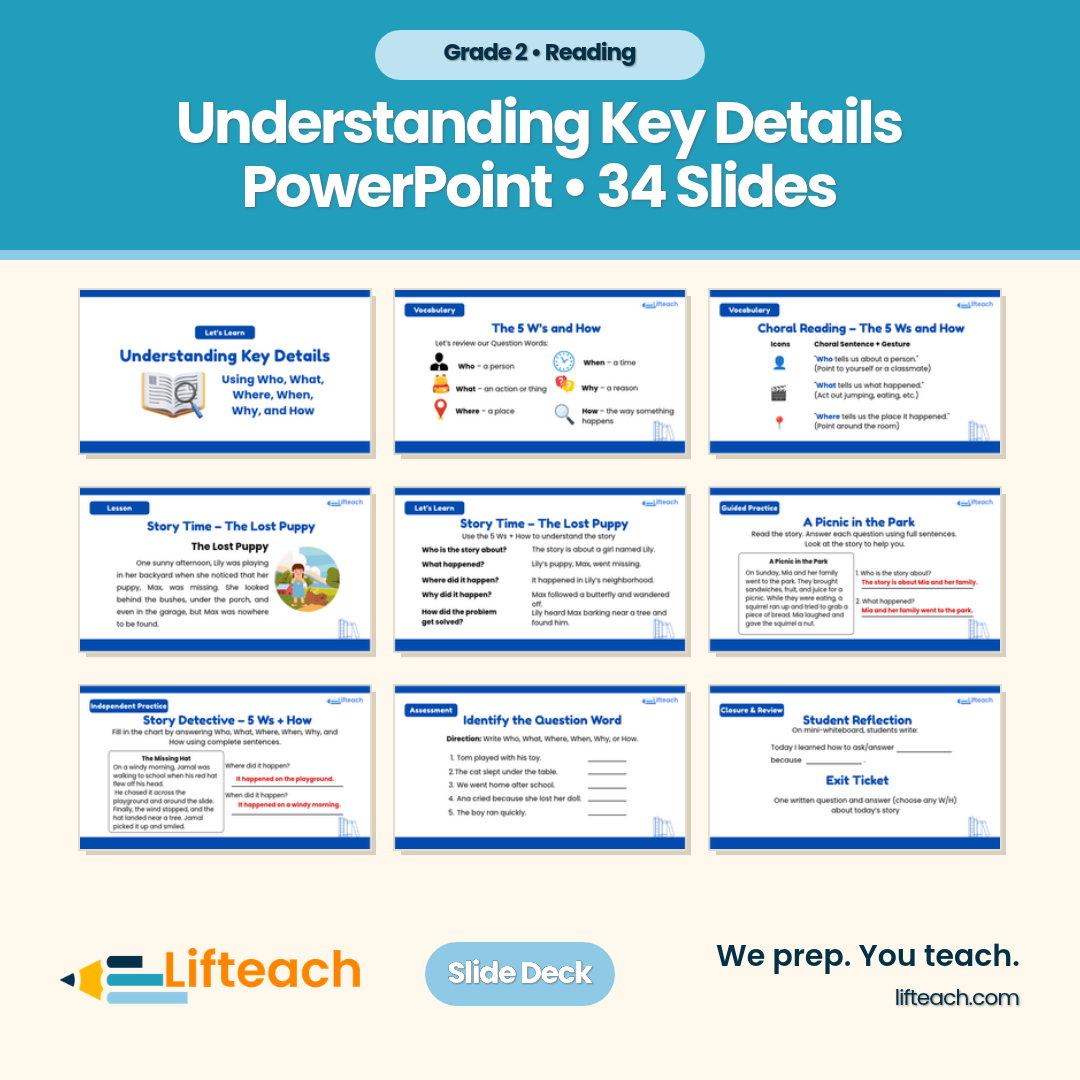
| 0–10 min | Warm-Up / Vocabulary | Question-word charades with the cards, then choral reading of each definition and gesture (Point to yourself for who, act out an action for what, and so on). | 1–4 | — |
| 10–20 min | Lesson Proper | Read aloud “The Lost Puppy” (Lily and Max). Model answering Who, What, Where, When, Why, and How, then review how the 5 Ws + How help us understand a story. | 5–15 | — |
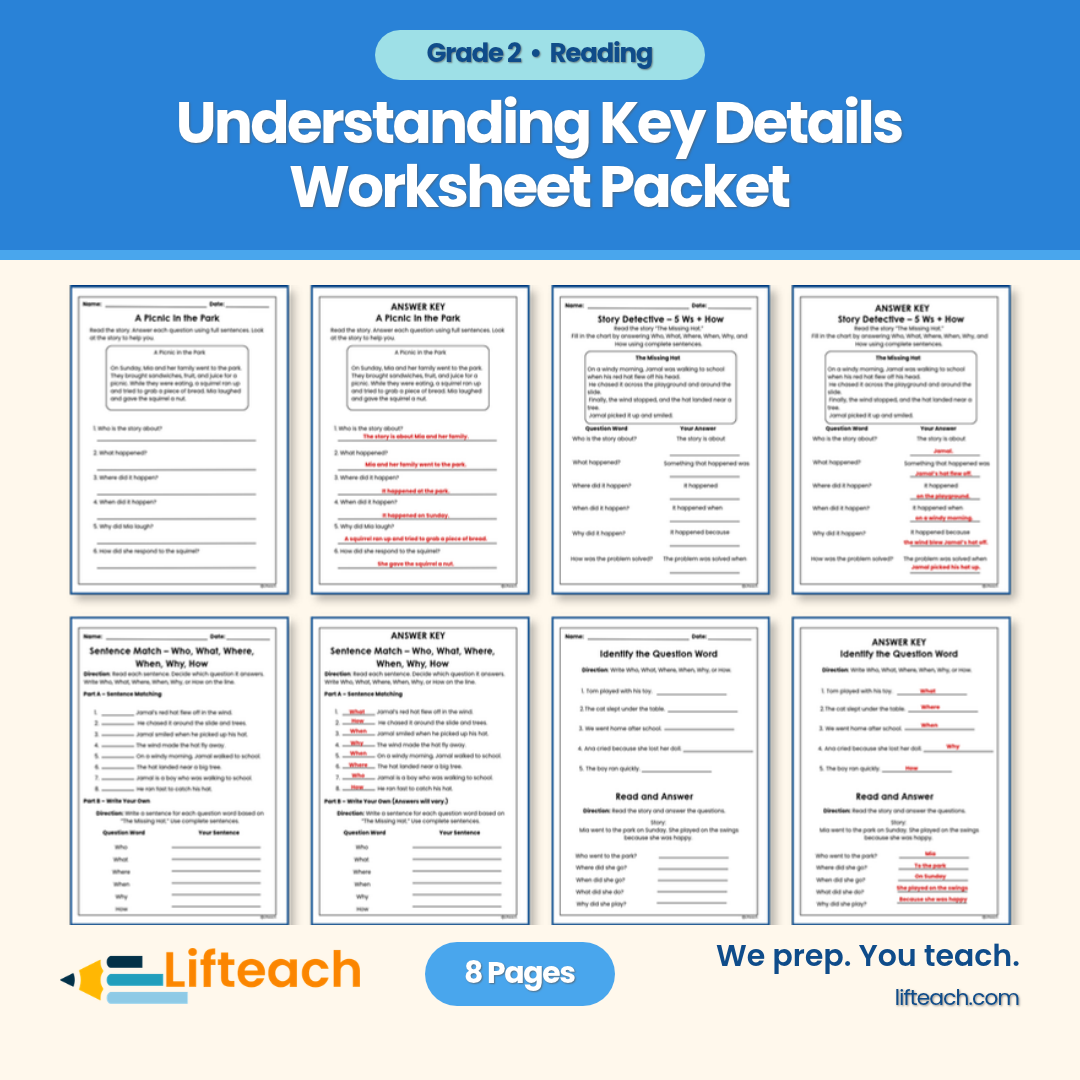
| 20–30 min | Guided Practice | Read “A Picnic in the Park.” Students answer the six questions in complete sentences. Review as a class. | 16–20 | 1–2 |
| 30–40 min | Independent Practice | Story Detective: students read “The Missing Hat” and complete the 5 Ws + How chart in complete sentences. | 21–25 | 3–4 |
| 40–50 min | Closure & Review | Students write on a mini-whiteboard: “Today I learned how to ask/answer _____ because _____.” Collect a one-question exit ticket if time allows. | 26 | — |
Assessment pages (Sentence Match, Identify the Question Word, and Read and Answer; Slides 27–33, Worksheet pages 5–8) can be used as a follow-up check or homework. They will not fit comfortably inside the 50-minute lesson.
6. Instructional Activities & Strategies
Warm-Up / Hook 10 min
- Teacher says/does: Hold up a question-word card without saying the word. Students act out the meaning (point to themselves for “who,” motion a location for “where”). The class calls out the word once someone guesses correctly.
- Teacher says/does: Display each word with its icon on Slides 2–4. Students repeat the definitions chorally and practice the gestures.
- Students do: Act out and say each question word.
Teacher Tip: Keep the charades moving. If a word is sticky, model the gesture once, then have the whole class join in.
Direct Instruction 10 min
- Teacher says/does: Read “The Lost Puppy” on Slides 5–7 (Lily notices that her puppy, Max, is missing; she asks the neighbors; Max had followed a butterfly; Lily finds him and hugs him).
- Teacher says/does: Think aloud with the 5 Ws + How (Slides 8–12): Who is the story about? What happened? Where was she? When did it happen? Why did the puppy go missing? How did Lily find Max?
- Teacher says/does: Use Slides 13–15 to sum up: answering these questions helps us find the most important details and remember the story.
- Students do: Answer the modeled questions with the teacher and repeat the six question-word meanings.
Guided Practice 10 min
- Teacher says/does: Introduce A Picnic in the Park (Worksheet page 1; answer key on page 2). Read the story together.
- Students do: Answer each question in a complete sentence, looking back at the story.
- Teacher says/does: Review answers on Slides 16–20. Prompt: “Which question word did that answer?” After the Canva fixes, the first question should be a Who question about Mia and her family.
Teacher Tip: If students write one-word answers, point back to the direction “use complete sentences” and offer a stem such as “It happened at _____.”
Independent Practice 10 min
- Teacher says/does: Introduce Story Detective – 5 Ws + How (Worksheet page 3; answer key on page 4). The deck labels this “Guided Practice”; use it as independent work.
- Students do: Read “The Missing Hat” and complete the chart in complete sentences.
- Teacher says/does: Circulate and prompt students who skip Who (Jamal) or who write “school” for Where — the action is on the playground / on the way to school.
Closure & Review 10 min
- Students do: On a mini-whiteboard, write: “Today I learned how to ask/answer _____ because _____.”
- Teacher says/does: If time allows, collect a one-question exit ticket (any W/H about today’s story). Review a few responses aloud using Slide 26.
Teacher Tip: Save Sentence Match (pages 5–6), Identify the Question Word, and Read and Answer (pages 7–8) for the next day or homework so the 50-minute block stays intact.
7. Assessment Methods
- Formative:
- Observation during charades and the Picnic review.
- Story Detective chart answers in complete sentences.
- Mini-whiteboard reflection and optional exit ticket.
- Summative (follow-up or homework):
- Sentence Match: Read each sentence and write Who, What, Where, When, Why, or How.
- Identify the Question Word and Read and Answer: Label details, then answer questions about a short Mia story.
8. Differentiation Strategies
- Struggling Learners / ELLs:
- Leave the sentence stems on the Story Detective chart in place.
- Pair with a peer “question coach” and use highlighter to find clues in the text.
- Use the question-word cards and gestures throughout the practice pages.
- Advanced Learners:
- Write one extra “how” or “why” question of their own about “The Missing Hat.”
- Compare two characters (Mia and Jamal, or Lily and Max) using the 5 Ws + How.
9. Worksheets
| Worksheet | Pages | What’s on it |
|---|---|---|
| Worksheet 1: A Picnic in the Park | 1–2 | Short picnic story about Mia and her family. Six questions to answer in complete sentences. Answer key included. After the Canva fixes, the set should include a clear Who question. |
| Worksheet 2: Story Detective – 5 Ws + How | 3–4 | Students read “The Missing Hat” and complete a chart. Answer key included. After the Canva fixes, the first row should be Who (Jamal). |
| Worksheet 3: Sentence Match | 5–6 | Part A: label eight sentences as Who, What, Where, When, Why, or How. Part B: write an original sentence for each question word. Answer key for Part A included; Part B answers will vary. |
| Worksheet 4: Identify the Question Word / Read and Answer | 7–8 | Label five sentences with the question word they answer, then answer Who, Where, When, What, and Why about a short Mia story. Answer key included. |
10. Reflection & Next Steps
- Teacher Reflection:
- Which question words did students use confidently? Which ones (often why or how) need a mini-lesson?
- Did students answer in complete sentences, or only with one-word labels?
- Student Reflection:
- “Which question word helps you most when you read a story? Why?”
PowerPoint Lesson